


A lot can change in 10 years.
We’ve recently celebrated our 10th birthday, marking a decade of development, innovation and support.
Although it only feels like yesterday that the first 20i website went live, the web industry has changed massively in that time.
Infrastructure, technology, and workflows have all undergone significant change – with arguably the biggest one occurring right now!
We decided to take a look at some of the biggest shifts that have occurred between 2016 and today.
Did you know…
- Around 40% of all websites are running on WordPress, up from 25%.
- .com domains reported 166.6 million registrations in 2026 (up from 126.9 million in 2016!)
- Mobile devices account for more than 60% of the global traffic.
- In 2016, roughly 44% to 50% of browser requests were loaded over HTTPS. Today, that figure is around 97%.
- In January 2016, SVG was found on just 1.4% of websites. Today, it appears on around 67.6%.
- The median mobile homepage has grown from 800 KB around 2.6 MB.
Read on for these, and more stats lookin back on how much has changes in the past 10 years!
WordPress took an even bigger share of the web
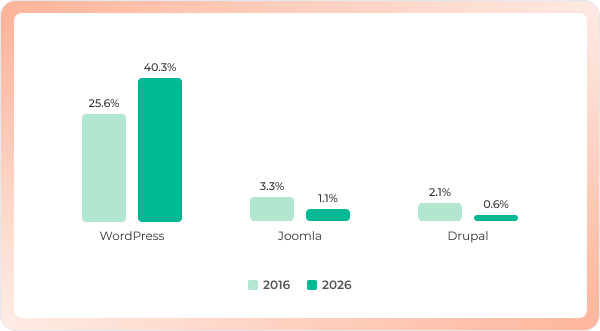
WordPress was already a dominant power in the CMS’ market in 2016, powering 25.6% of all websites.
But that figure has continued to surge.
Today, around 40.3% of all websites are running on WordPress.
Among websites using a known CMS, that number climbs to 58.8% of the market.
The source of this growth has been two fold – an increasingly “digitally connected” global population building more websites accounts for a large chunk, whilst competitors market shares have been eaten in to also.
Over those 10 years, Joomla! fell from 3.3% of the web to 1.1%, while Drupal dropped from 2.1% to 0.6%.
Interestingly, WordPress’ market growth has plateaued in recent years perhaps signalling a big shift in the way that people build websites (more on that later…), but it still remains the dominant force.
It has also continued to grow in the ecommerce sector, with WooCommerce total market share increasing from around 3.5% in 2018, to 8% today.
Laravel grew into a much larger development ecosystem
Like WordPress, PHP framework Laravel was already an industry leader in 2016, but its scale today is very different.
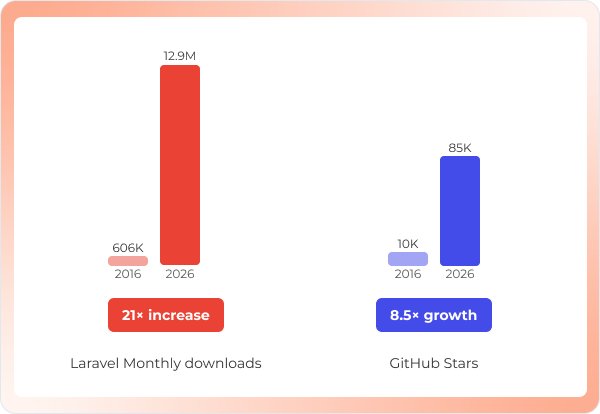
In January 2016, Laravel recorded around 606,000 Packagist downloads per month. In 2026, that figure is around 12.9 million per month.
That is an increase of more than 21 times.
Laravel’s main GitHub repository has also grown from roughly 10,000 stars in March 2016 to around 85,000 today.
Our own Laravel Hosting continues to grow in popularity, and these numbers reflect a wider shift in PHP development. Modern applications are increasingly built around frameworks, dependency management, structured deployment processes and reusable packages rather than standalone PHP scripts.
Laravel has been one of the clearest examples of that change.
Server side development became more diverse
PHP remains the dominant server side language, but the market around it has become much more diverse.
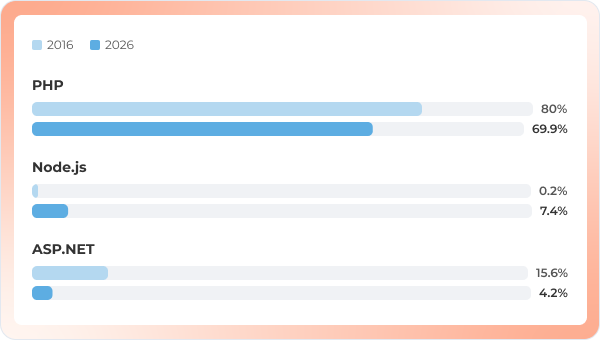
In 2016, PHP accounted for 80% of websites with a known server side language. Today, that figure is down 69.9%.
At the same time, server side JavaScript, including Node.js, increased from just 0.2% to 7.4%.
ASP.NET moved in the opposite direction, declining from 15.6% to 4.2%.
The important change is not that one technology replaced PHP. Instead, server side development has spread across a broader range of platforms and runtimes.
That diversity has changed hosting requirements too. Developers increasingly expect hosting platforms to accommodate different application stacks, runtime versions, deployment methods and development workflows rather than assuming every website follows the same model.
Hosting architecture moved beyond the single server
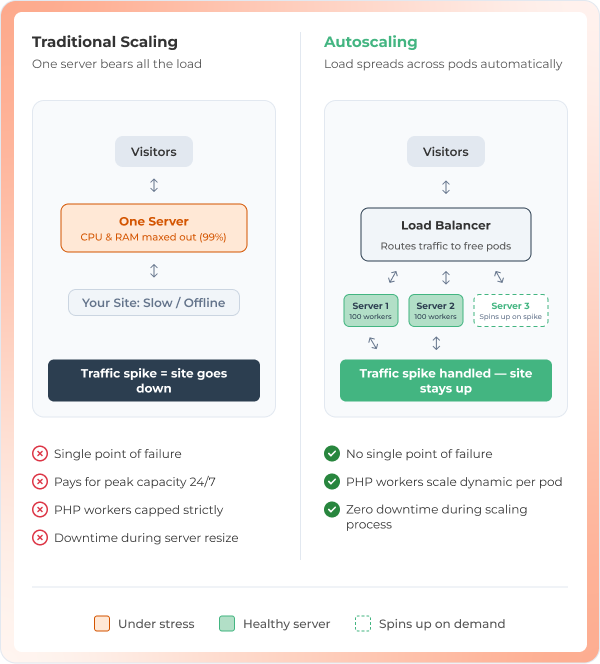
One of the biggest changes over the last decade has happened underneath the websites themselves.
Traditional hosting has typically been built around individual servers. A cPanel server, for example, hosts a set number of accounts within the CPU, memory and storage available on that machine.
That approach is predictable, but it creates fixed limits. If demand increases, capacity has to be added manually. A problem affecting the server can also affect every site relying on it.
Over the last decade, hosting infrastructure has increasingly moved towards distributed cloud platforms built around load balancing, redundancy and dynamic resource allocation.
The growth of Infrastructure as a Service reflects the scale of that transition. Global IaaS spending increased from around $22.4 billion in 2016 to a forecast $287 billion in 2026.
At 20i, our platform is built around the same architectural shift.
Rather than relying on a single server, resources can autoscale according to demand. Web, database, FTP and mail services operate across redundant infrastructure, while load balancing and automatic failover reduce reliance on individual components.
For developers, agencies and hosting providers, that means infrastructure can respond to traffic and workload changes without the same manual capacity planning associated with traditional hosting.
HTTPS went from optional to expected
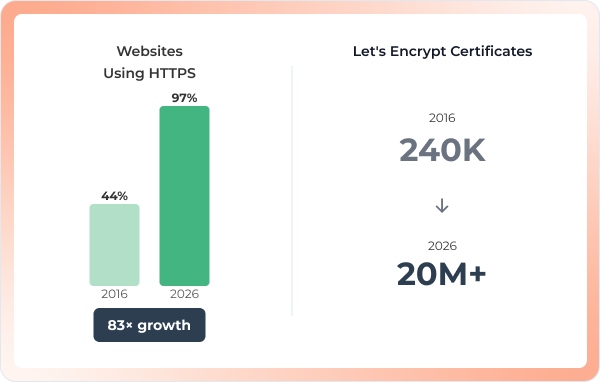
It almost feels like a given these days, but when 20i launched, HTTPS usage was far from universal
In 2016, roughly 44% to 50% of browser requests were loaded over HTTPS.
Today, that figure is around 97%.
The number had been climbing ever since Google announced HTTPS as a ranking factor in 2014, but the automation of SSL certificate issuance made adding an SSL a regular step within web development.
For comparison Let’s Encrypt had around 240,000 active certificates in early 2016. Today, that figure is more than 20 million.
Encrypted connections are now expected by browsers, users, search engines and developers.
Rapidly growing security threats
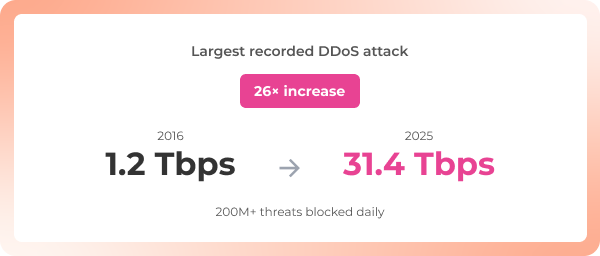
The scale of distributed denial of service attacks has also changed considerably.
In 2016, a 1.2 Tbps attack associated with the Mirai botnet made headlines.
By 2025, attacks had reached 31.4 Tbps.
That is around 26 times larger.
At those volumes, DDoS protection cannot be treated purely as an application or server level problem. An attack can overwhelm network capacity before traffic ever reaches the website itself.
This is why DDoS mitigation has increasingly become part of the underlying hosting and network infrastructure.
We’ve always had a strong focus on security, and this rapidly growing threat underlines why our enterprise level security continues to be a priority.
We continue to block over 200 million threats every day.
Core Web Vitals changed how website performance is measured
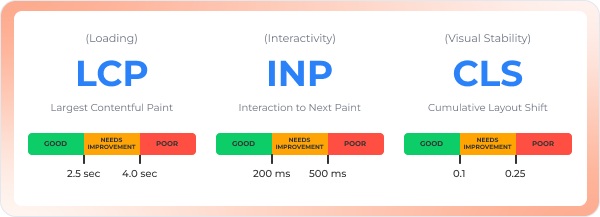
Website speed has always been important, but the introduction of Google’s Core Web Vitals put it much more into the spotlight.
Introduced in 2020, this set of metrics – Largest Contentful Paint, Interaction to Next Paint, and Cumulative Layout Shift – took the discussion beyond speed, onto specific page elements, and how they affect the overall browsing experience.
These factors became part of the Google ranking algorithm in 2021 which increased focused on them further, sometimes to a fault.
This increased focus on writing efficient code, compressing images and minimising render blocking resources.
It also made the performance of the infrastructure underneath a website more visible.
Caching, CDN delivery, and server response times all contribute to the experience measured by Core Web Vitals.
Websites became much heavier
While hosting infrastructure, browsers and networks became faster, websites also became considerably larger.
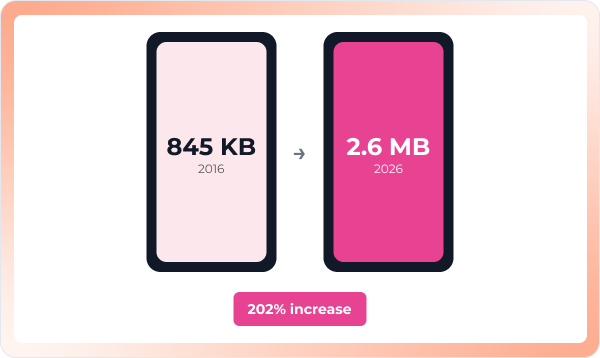
HTTP Archive reports a 202% increase in mobile page weight over the decade.
The median mobile homepage is now around 2.6 MB.
More JavaScript, larger images, video, web fonts, tracking scripts and increasingly sophisticated interfaces have all contributed to the amount of data browsers need to download and process.
That has created an interesting tension.
The technology used to deliver websites has improved significantly, but developers are asking that technology to deliver considerably more at the same time.
Mobile became the primary way people access the web
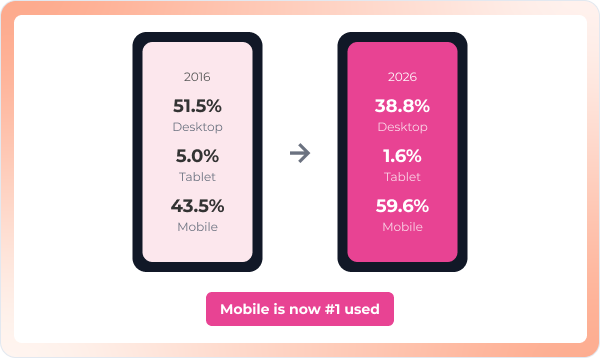
2016 was the year when mobile overtook desktop as the world’s primary internet platform for the first time.
Until then, web design was still largely approached as “desktop first”, with mobile often treated as a secondary version of the same experience. As mobile usage grew, that approach became increasingly difficult to justify.
Our own approach to design has changed a fair bit over the same period too, as this look back shows.
Today, mobile accounts for more than 60% of global traffic, but usage varies significantly by market.
In mobile first countries such as India, mobile can account for more than 80% of traffic, while in some Western or business focused markets it can be closer to 40%, with desktop retaining a much larger share.
Tablet browsing has moved in the opposite direction, falling from around 5% of traffic in 2016 to just 1.6% in 2026.
For developers and designers, the important change is not simply that mobile has grown.
Audiences now access websites through very different combinations of devices, screen sizes, connection types and usage contexts. Responsive design has therefore moved from being a useful feature to a baseline requirement, while understanding the device profile of a specific market has become increasingly important when designing and optimising for that audience.
New domain extensions
The last decade has also given website owners far more choice over what comes after the dot.
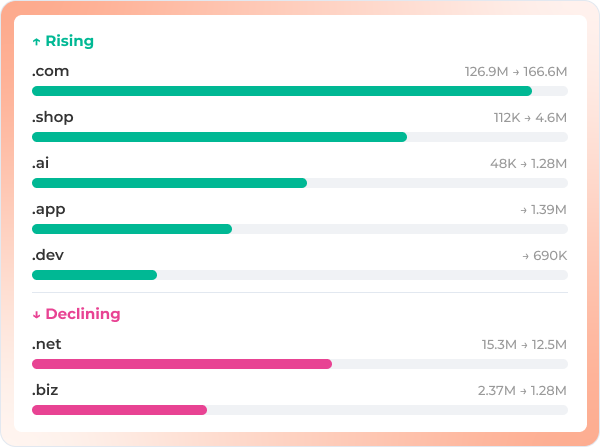
.com remains comfortably the largest extension, growing from 126.9 million registrations in 2016 to 166.6 million in 2026.
Some newer extensions have grown quickly.
.shop had just 112,815 registrations at the end of 2016. Today, it has around 4.6 million.
Other established extensions have declined. .net fell from 15.3 million registrations to 12.5 million, while .biz dropped from around 2.37 million to 1.28 million.
There are also extensions that simply did not exist as public registration options when we started.
.app now has around 1.39 million registrations, while .dev has around 690,000.
Perhaps the most interesting change is .ai.
Technically, .ai is the country code domain for Anguilla and predates 2016. But its use has changed dramatically alongside the AI industry.
It had around 48,000 registrations in 2018. By June 2026, that had grown to roughly 1.28 million.
A niche country code effectively became a globally recognised technology domain.
Image formats adapted to the modern web
The way websites deliver images has changed too.
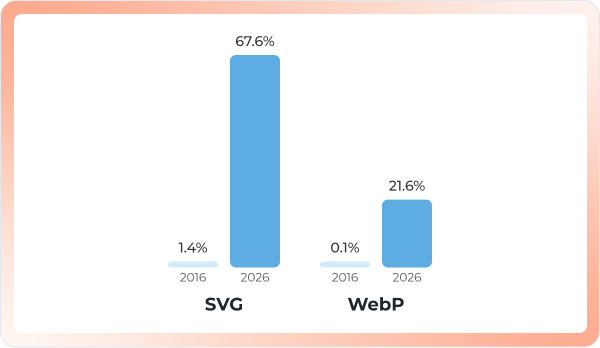
In January 2016, SVG was found on just 1.4% of websites.
Today, it appears on around 67.6%.
SVG is particularly well suited to responsive interfaces because graphics can scale without losing quality. That makes the format useful for logos, icons, illustrations and interface elements across devices with different screen sizes and pixel densities.
WebP saw similarly significant adoption from a much smaller starting point.
It grew from less than 0.1% of sites in 2016 to around 21.6% today.
The format offers more efficient compression than older raster formats in many cases, helping reduce image transfer size without requiring a significant reduction in visual quality.
As pages became heavier and performance became more closely measured, efficient image delivery became increasingly important.
AI became part of everyday web development
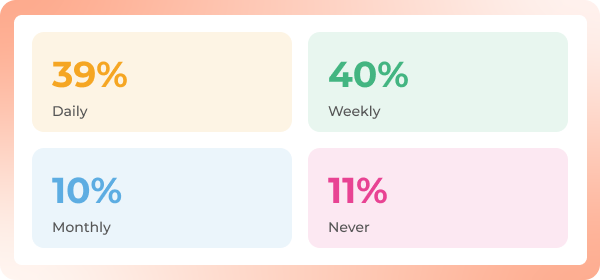
Perhaps no change feels more significant today than AI.
In 2016, AI was not part of the mainstream web development workflow.
Today, our own research shows that 79% of people working in the web industry use AI tools every week.
Developers and designers are using AI to write code, debug applications, generate content, create page layouts and increasingly build complete websites and applications.
The growth of what is sometimes described as vibe coding takes that further.
People who may previously have selected an existing CMS, theme or application can increasingly describe what they want and use AI assisted tools to create something themselves.
It is still early, but that has the potential to change both how websites are built and what hosting platforms are expected to support.
Exclusive Survey: How Businesses are Using Vibe Coding and the Risks They Face
The network stack underneath websites changed too
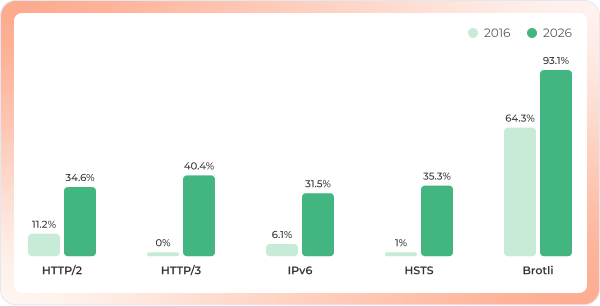
Some of the decade’s biggest changes are largely invisible to website visitors.
HTTP/2 was used by 11.2% of websites in January 2016. Today, that figure is 34.6%.
HTTP/3 did not exist as a standard in 2016. It is now detected on 40.4% of websites.
IPv6 adoption increased from 6.1% to 31.5%.
HSTS grew from 1% to 35.3%.
Compression increased from 64.3% to 93.1%.
Taken together, these changes have improved how browsers, networks and servers communicate.
Connections can be established more efficiently, content can be transferred with less overhead and security protections can increasingly be enforced automatically.
They may not be changes most website visitors notice directly, but they have helped shape the performance and reliability expectations developers now take for granted.
Ten years of building for a changing web

Looking back at 2016 makes it clear how much has changed beneath the familiar surface of the web.
WordPress became even more dominant. Laravel grew into a much larger ecosystem. Server side development diversified. HTTPS became standard. New protocols arrived. Websites became heavier and performance became easier to measure.
At the infrastructure level, fixed single server hosting has increasingly given way to distributed platforms built around redundancy, load balancing and autoscaling.
And now AI is beginning to change the development process itself.
For us, that change is part of what makes building hosting technology interesting.
The websites and applications people create will continue to evolve. Our job is to make sure the platform underneath them evolves too.