



As excitement builds around the 2026 FIFA World Cup, FIFA is projecting six billion viewers worldwide, in what could become the most watched sporting event in history.
Whether you’re attending matches in-person across the U.S., Canada and Mexico, or following the action from fan zones, experiencing the tournament alongside other fans is a huge part of the appeal – with sports fans ranking community engagement as a top priority when watching live events.
But following a month-long tournament across North America isn’t always realistic for many football fans.
Between accommodation costs, travel expenses and work commitments, taking weeks off to fully immerse yourself in the World Cup can feel out of reach.
That’s where the rise of remote and hybrid working has changed the game.
As flexible working has become more common (our web designer survey showed 80% of digital creatives work either remote or hybrid) the 2026 World Cup presents a unique opportunity for fans to base themselves in a host city and balance their day job with matches, fan zones and the wider tournament atmosphere.
➡️ To find out which destinations offer the best balance of remote-work friendliness, we analysed all 16 FIFA World Cup 2026 host cities across the U.S., Canada and Mexico against 10 key indicators for fans who will be working while watching the games.
From internet speeds and coworking availability to accommodation options and safety, our research reveals the best cities to work remotely while following the tournament.
Key Findings
- Toronto was revealed as the best host city overall for remote workers following the 2026 World Cup.
- Canada’s host cities took the top two spots, with Vancouver ranking second overall.
- Houston and Philadelphia scored high for connectivity, places to stay, and cybersecurity.
- Mexico’s host cities ranked high for affordability and wider accommodation choice, but lower for cybersecurity.
- Los Angeles, Seattle and the San Francisco Bay Area ranked lowest due to higher overall expenses and fewer budget-friendly stays near stadiums.
- Boston offered no affordable accommodation within walking distance of its stadium for fans.
The results show that some of the tournament’s most recognizable destinations scored lower for remote work-friendliness despite their popularity with tourists and football fans.
Remote workers following the 2026 World Cup tournament may benefit more from cities offering a balance of digital infrastructure and affordability, rather than simply choosing the biggest host destinations.
Best cities to remote work and follow the 2026 World Cup
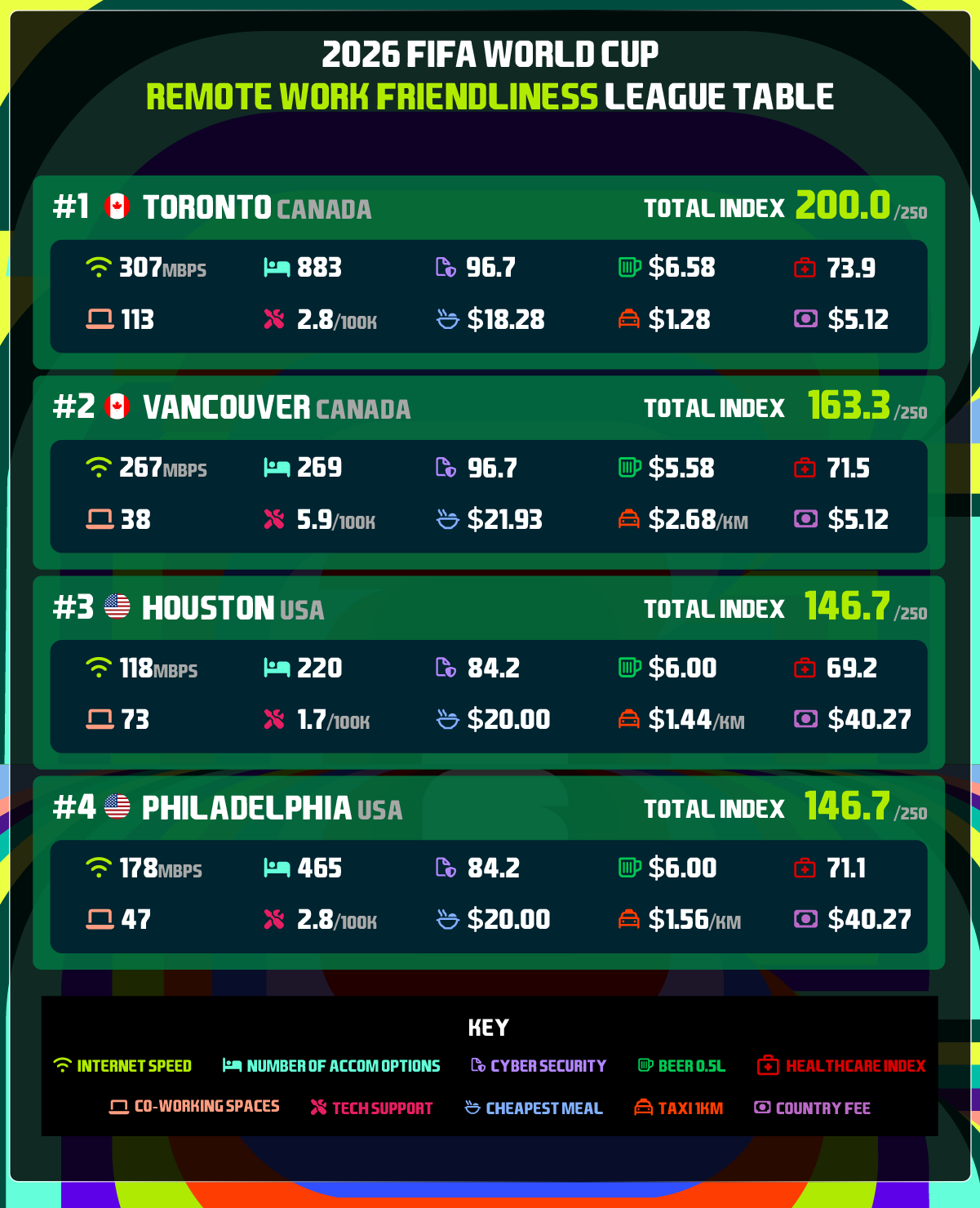
Canada’s host cities ranked on top overall for remote workers following the 2026 World Cup. Toronto scored the number 1 spot, with the highest internet speeds and availability of affordable accommodation, alongside high quality of local healthcare and low probability of cyber threats on public networks.
Vancouver followed, also with strong connectivity, healthcare, and national cybersecurity, helping give both employers and remote workers greater confidence in working securely outside their usual networks during the tournament.
Houston and Philadelphia tied for third overall, though rank highest out of the U.S. host cities, thanks to their balance of affordability, connectivity and accommodation access.
The full league table of the best world cup host cities for remote work can be seen below.
Coworking spaces
The New York New Jersey host area offered the most available coworking spaces at 266 and ranked fifth overall. This gives remote workers greater flexibility to find reliable workspaces with stable internet access and a professional set up between matches and fan events.
Mexico City and Toronto follow with 171 and 113 respectively, reinforcing their appeal for digital nomads and travelling professionals planning longer stays during the tournament.
Whereas Kansas City offered the least coworking spaces, at 13, making it trickier for fans hoping to balance remote work with matchdays.
Cybersecurity
Mexico’s host cities have a notably poorer national cybersecurity score than any other, at 38.33 out of 100 – well below the ‘good’ benchmark at 80 points – due to weaker national cyber defence capabilities, lower digital resilience, and gaps in cyber threat preparedness compared with other tournament host nations.
This means remote workers may need to take additional security precautions to protect business data while travelling, such as using VPNs or virtual private server solutions.
Whereas Canada ranked second globally for cybersecurity and, alongside the U.S., achieved strong scores of 96.67 and 84.17 respectively, reflecting their more advanced threat defence systems.
Internet speeds
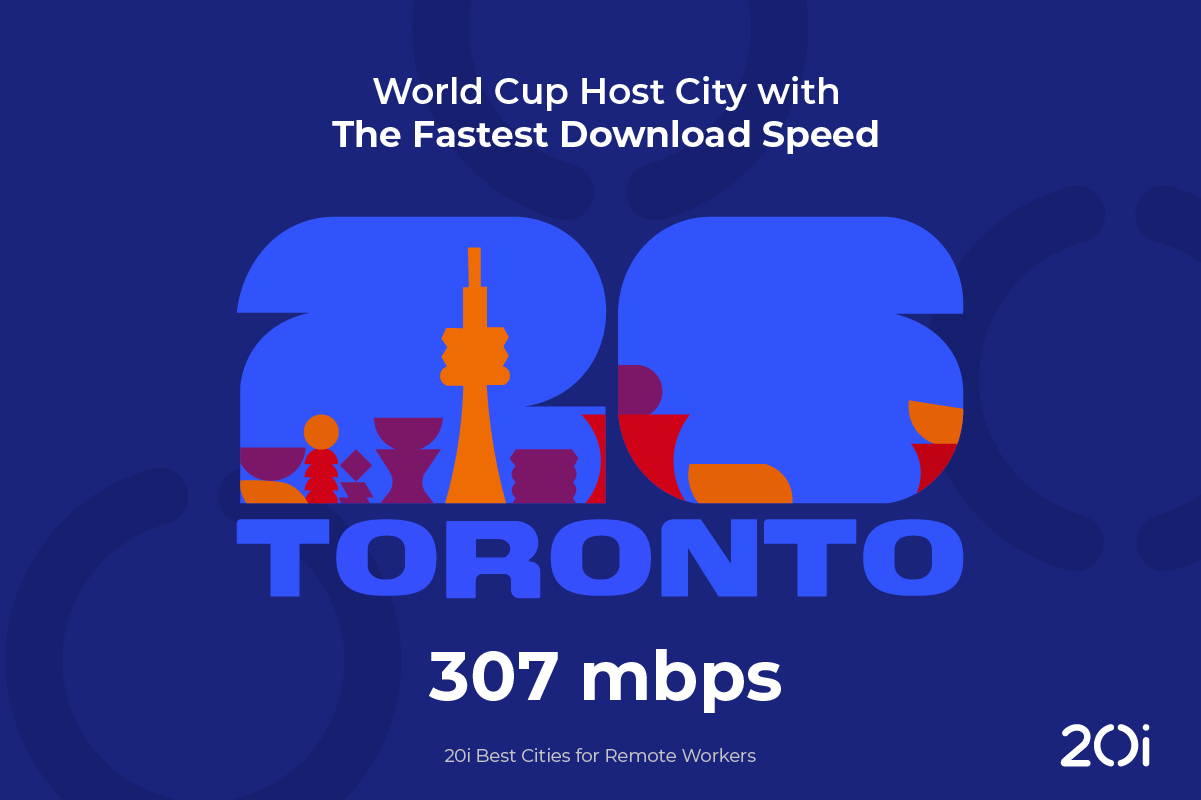
Toronto recorded the fastest fixed broadband download speeds of all host cities at 307.36 Mbps, followed by Vancouver at 267.29 Mbps and Miami at 216.14 Mbps.
Download speeds affect how smoothly users can stream video calls and transfer files. Speeds above 200 Mbps are generally considered excellent for remote working with multiple connected devices, while the minimum recommendation is at least 100 Mbps per person working from home.
All U.S. host cities performed strongly, with Boston, New York New Jersey, Dallas, and Houston all averaging speeds above 175 Mbps.
Mexico’s host cities recorded the slowest broadband speeds overall, with Mexico City averaging 43.61 Mbps. While still usable for everyday tasks and video calls, slower connections may struggle with larger files or multiple connected devices. Remote workers visiting these cities may want to prioritize coworking spaces or accommodation with verified high-speed Wi-Fi.
Cost of living
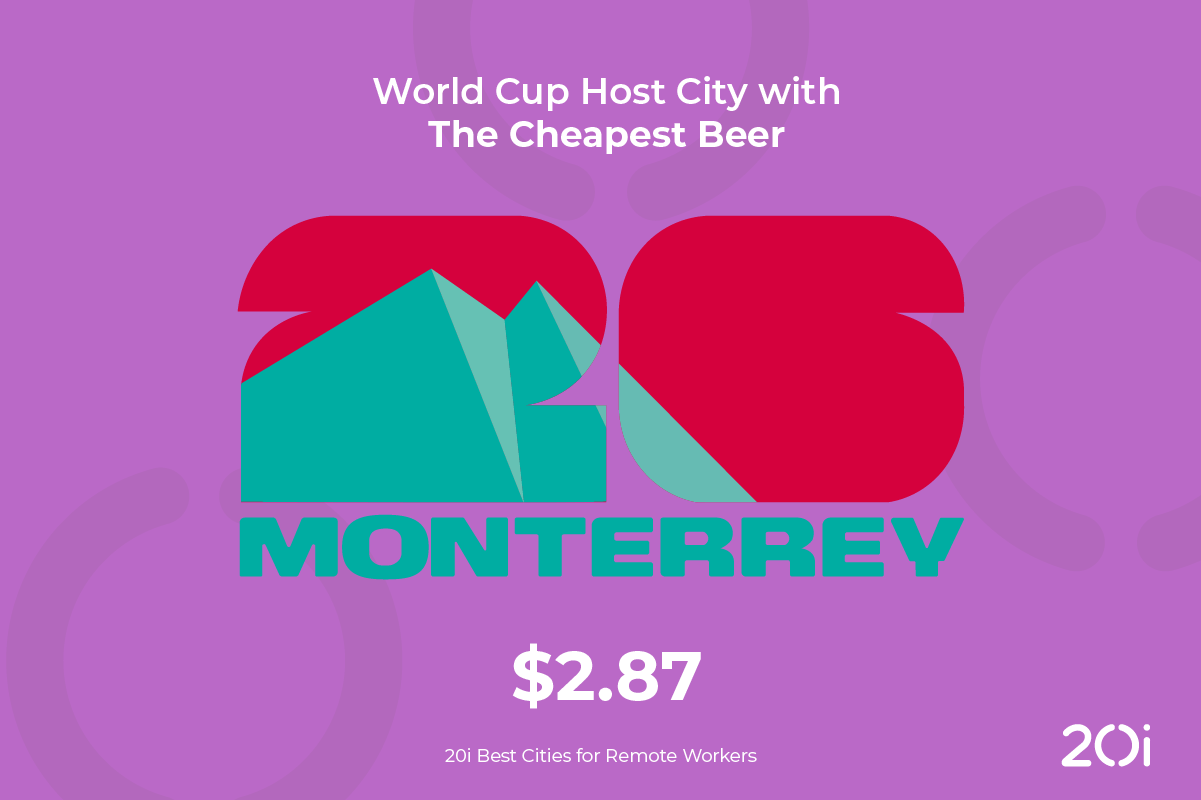
Mexico’s host cities performed strongly in several affordability-related categories. Guadalajara and Mexico City both ranked in the top half, helped by higher availability of affordable accommodation options, and lower cost food, drink and taxis compared to other U.S. host cities.
Across Mexico’s host cities, a pint of draft beer can average around $3.02, while taxi fares average around $1.02 per kilometre – dropping to 46 cents in Mexico City. A meal at an inexpensive restaurant averages $12.46, less than half of a similar meal in Miami, where it reaches $30.
U.S. host cities were generally more expensive overall, averaging around $24.09 for a relaxed meal out, $7.27 for a draft beer, and $1.73 per kilometre for a taxi ride.
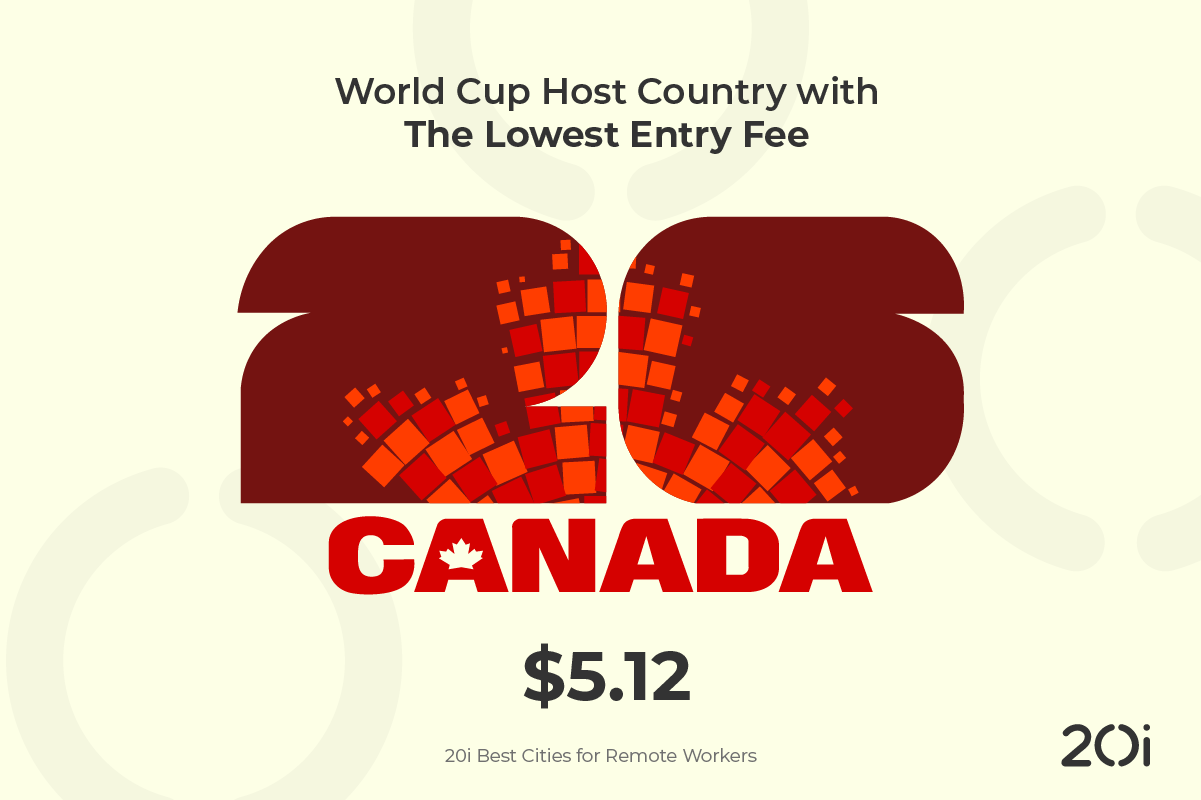
In Canada, a meal at an inexpensive restaurant averages around $20.15, while a pint costs around $6.22, and taxi fares average $1.68 per kilometre. It also has the highest tourist entry fee among 2026 World Cup host countries at $40.27, compared to just $5.12 in Mexico.
The cost of a cheap meal and a local beer in each World Cup host city:
Accomodation options
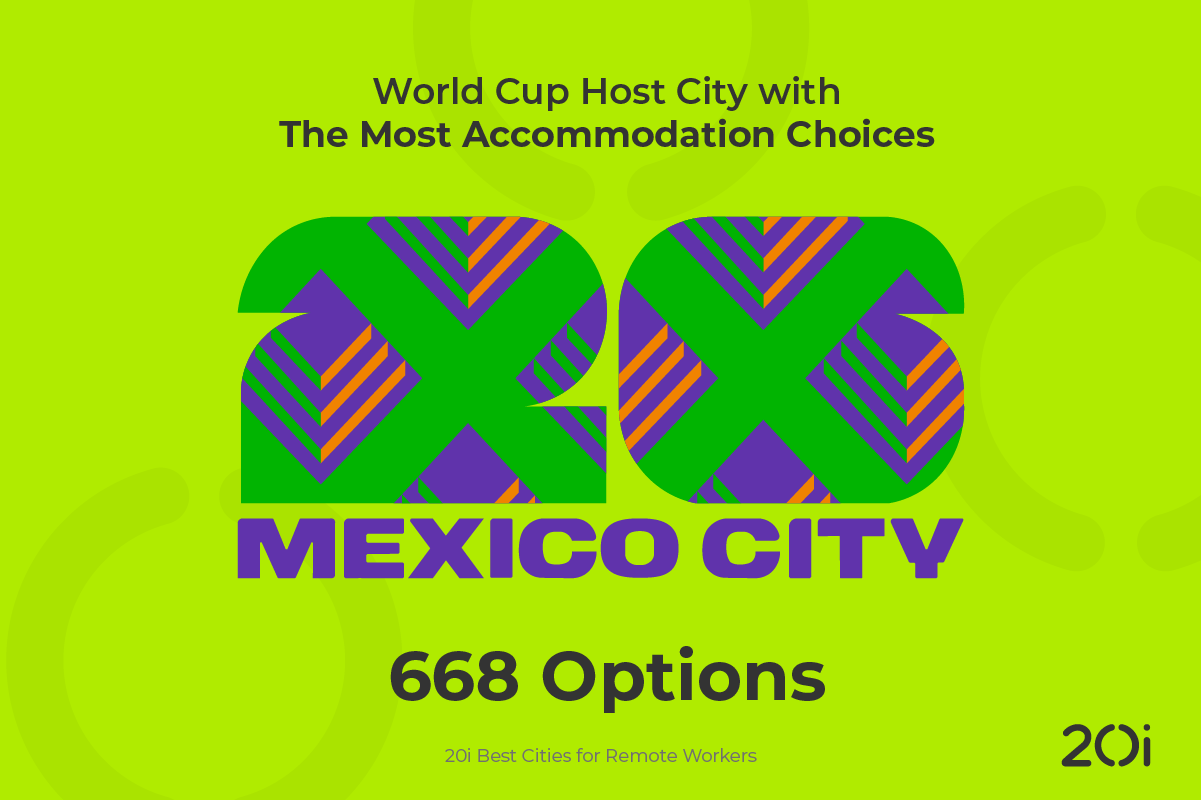
Across Booking.com and Airbnb, no available accommodation was found within 1km of Boston Stadium for under $4000 for 7 nights. Atlanta offered just one choice, followed by Dallas with 17, and the San Francisco Bay Area with 20. This means fans would need deeper pockets or to find affordable accommodation further out, which could incur higher travel costs.
Cities including Kansas City and Seattle also had less than 50 affordable accommodation choices within walking distance of their stadiums for fans.
At the other end of the scale, Canadian and Mexican top the table, with Mexico City having by far the highest number of affordable accommodation options available.
The full list can be seen below.
Transport costs
We looked at the best cities for accommodation within walking distance (1km) of the host city stadiums, factoring in the price of a 1km taxi journey in between, which varies little across host cities. However, wider city transport costs for those traveling to stadiums have skyrocketed in some areas.
New York New Jersey and Boston have faced criticism over special matchday transport pricing, with return train fares to MetLife Stadium initially increasing from around $13 to $150 before later being reduced to $98, while train tickets to Boston Stadium rose 300% from $20 to $80 during tournament games.
In contrast, some U.S. host cities have taken a more fan-friendly approach. Philadelphia will provide free train travel for supporters leaving matches, while other cities are mostly sticking to standard fares rather than increasing them. Kansas City is also offering free bus travel for fans from the airport to the fan festival in the city center.
Timezone friendliness
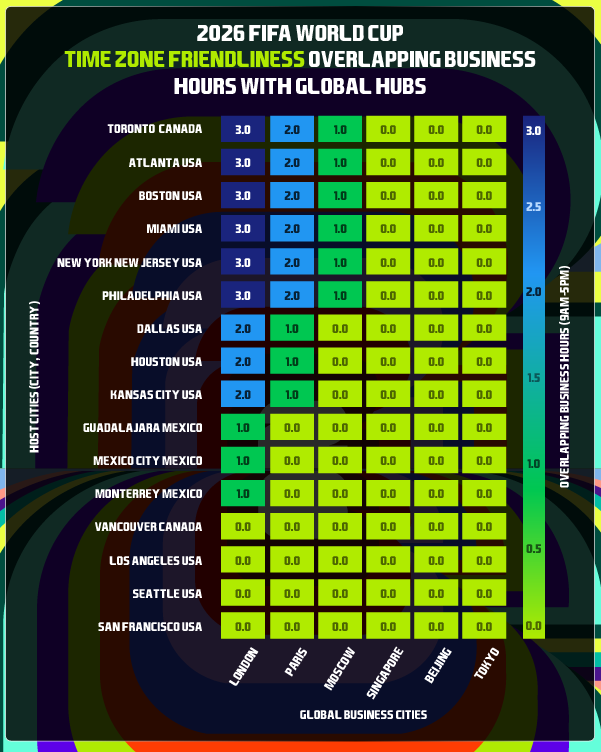
Time zone differences could also impact how practical each host city is for remote workers balancing meetings and match schedules during the tournament, although this factor was not included in the overall rankings.
East Coast host cities including Toronto, Atlanta, Philadelphia, Boston and New York New Jersey offered the strongest overlap for fans working European business hours, with up to three overlapping working hours with London-based teams.
Meanwhile, West Coast destinations including Vancouver, Seattle, Los Angeles and the San Francisco Bay Area offered no overlapping business hours with UK or European working schedules, meaning remote workers would need to start earlier or finish later to stay connected with teams back home.
The data also showed that none of the host cities offered overlapping standard business hours with major Asia-Pacific cities including Beijing, Tokyo and Singapore.
Methodology
We analysed 16 host cities for the 2026 FIFA World Cup against 10 relevant index points to identify the most remote work-friendly locations for following the tournament. The data points included:
- Internet connectivity (HighSpeedInternet.com; Data Globe Hub)
- Workspace availability (Coworker)
- Accommodation within 1km (Booking.com; Airbnb)
- Nearby technology support (Google Maps)
- Cost of living (Numbeo: inexpensive meal, draught pint, 1km taxi)
- Local Healthcare System Index (Numbeo): A ‘good’ score is generally above 70 points.
- National Cybersecurity Score (NCSI): A ‘good’ score is generally above 80 points.
Each city was scored from 0-25 across all indicators based on relative performance (e.g. greater accommodation availability received higher scores). Scores were then aggregated to produce a total out of 250, with higher scores indicating greater remote work friendliness. Data correct from April 2026.