


Vibe coding has quickly moved from a niche trend into a workplace fixture, giving more people a way to build and maintain software & web applications.
Major technology companies including Spotify, Google and Microsoft are using AI heavily as part of their development workflows, while employers are now referencing AI coding tools such as Cursor and Claude Code in job descriptions, seeking candidates who can use them across roles including design, marketing and operations.
By lowering the technical barrier to entry, vibe coding is enabling non-developers to create internal tools, automate repetitive tasks and prototype new ideas without relying on engineering teams.
However, making web development more accessible also introduces challenges.
Without appropriate oversight, AI-generated code can introduce security vulnerabilities, expose sensitive data, create compliance risks and result in poorly documented applications that become difficult to maintain.
To understand how this shift is changing the workplace, we surveyed 600 non-developers to see how organisations are using AI coding tools, what they’re building and whether businesses have the policies and safeguards in place to safely manage the rise of vibe coding.
Key Findings
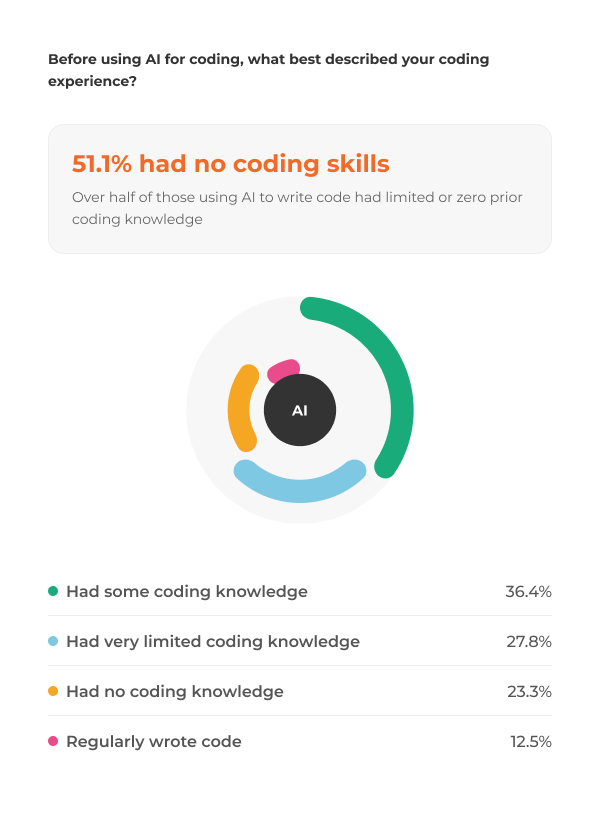
- AI is creating a new generation of coders: Just 12.5% of respondents regularly wrote code before using AI tools, while 51.1% had very limited or no prior coding knowledge.
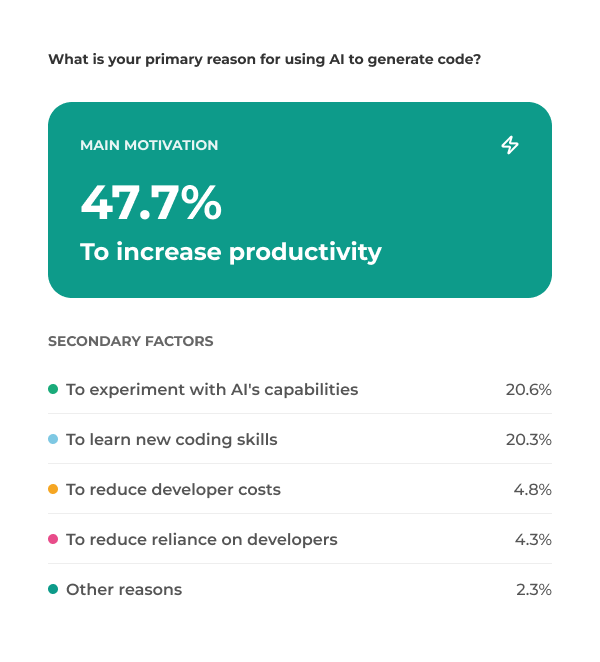
- Productivity is driving adoption: Nearly half (47.7%) of respondents use vibe coding primarily to improve productivity.
- Most AI-generated code isn’t professionally reviewed: Fewer than a third (31.5%) have their AI-generated code checked by a professional developer, while 9.3% do not verify it at all.
- Trust remains the biggest challenge: More than four in five (83.8%) have encountered issues with AI-generated code, with 35.2% saying their biggest challenge is knowing whether they can trust the output.
- Governance is failing to keep pace: Two thirds of organisations either have no formal guidance on workplace vibe coding or rely on informal policies, despite one in five respondents (20.5%) reporting that AI-generated code has contributed to a security breach.
Vibe coding is being adopted to enhance productivity, not replace people
Following a wave of predictions about AI replacing the human workforce, along with some high-profile examples of businesses reducing headcount while investing in automation, there has been growing debate over whether AI will replace roles or augment them.
However, our research suggests that, at least in the case of coding, workers are primarily using these tools to enhance productivity rather than remove the need for people.
Nearly half (47.7%) of those surveyed use AI coding tools primarily to increase productivity, making it more than twice as popular as the next most common reasons: experimenting with AI’s capabilities (20.5%) and learning new skills (20.3%).
The same pattern appears at an organisational level. Improved productivity is cited as the biggest impact of AI-assisted coding by 39.7% of respondents, followed by increased innovation (20.2%).
Adoption is also spreading across different levels of seniority, with mid-level employees (36.3%) and managers or heads of department (32.7%) among the biggest user groups.
However, the productivity gains are not yet translating into universal business-wide transformation.
Almost one in five respondents (19.5%) say AI-assisted coding has had no significant impact on their organisation so far, suggesting that while individuals are seeing clear benefits, businesses are still working out how to integrate these tools effectively at scale.
AI coding is becoming part of everyday work
Vibe coding is becoming a regular workplace activity, helping non-developers handle a wide range of technical tasks without needing developer input every time.
More than one third (36.4%) of non-developers use AI coding tools at least weekly, including 14.8% who use them several times a week, 13.8% weekly and 7.8% daily.
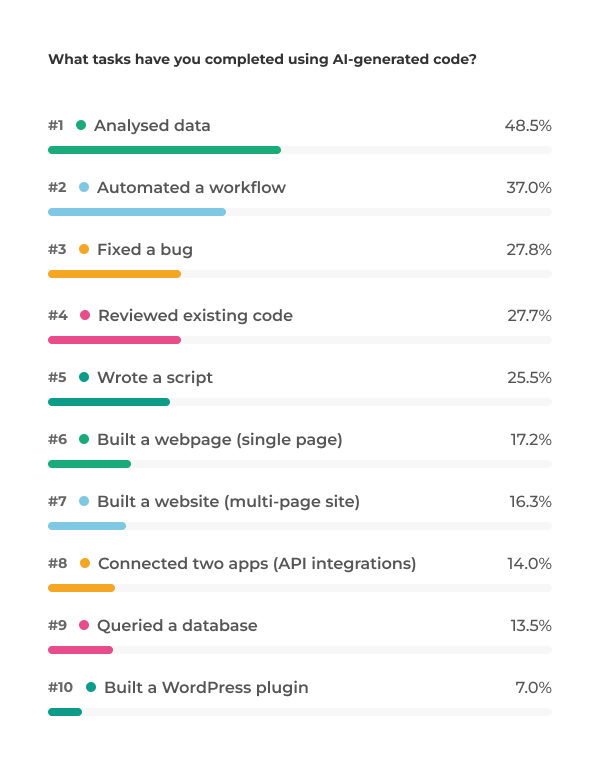
Nearly half (48.5%) use AI tools for data analysis, while workflow automation (37.0%), bug fixing (27.8%), code review (27.7%) and script writing (25.5%) are also common applications.
This further suggests that AI is being used less as a replacement for development teams and more as a way for employees to solve problems themselves, automate routine work and get technical tasks moving without waiting for specialist resources.
However, the survey also shows that AI coding is moving beyond these everyday productivity tasks
Expanding scope raises fears around trust and oversight
As non-developers take on more complex development work, the consequences of errors become more significant.
Around one in six respondents use AI to create single web pages (17.2%) or entire websites (16.3%), while others are using it for API integrations (14.0%), database querying (13.5%) and creating custom plugins (7.0%).
These use cases can carry greater technical and security risks.
An insecure API integration, unsafe database query or poorly implemented plugin can introduce vulnerabilities, expose data or create problems that are difficult to diagnose and maintain.
Despite this, verification processes remain largely informal. Six in 10 (61.0%) users self-test their own code, while fewer than a third (31.5%) have their work reviewed by a professional developer.
Others rely on another AI tool to check outputs (23.3%) or ask a non-developer colleague for feedback (20.2%), while 9.3% do not verify AI-generated code at all.
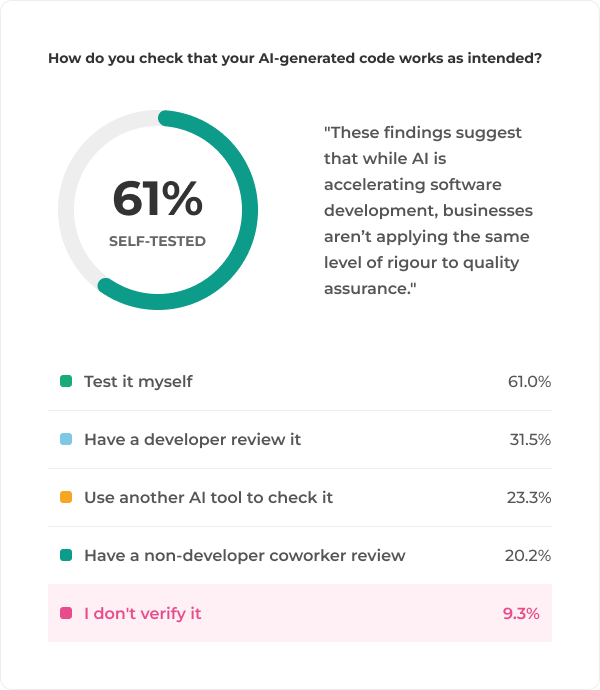
These findings suggest that while AI is accelerating software development, businesses aren’t applying the same level of rigour to quality assurance. As adoption of AI continues to grow, this lack of formal review processes could increase the risk of bugs, security vulnerabilities and unreliable code that makes its way into production.
Respondents were wary of these potential issues though, with 35.2% saying that their biggest challenge with vibe coding is knowing whether to trust the output.
This was followed by integration issues (27.0%), difficulty understanding the code (25.5%) and bugs (25.3%).
Half of AI coders didn’t code beforehand
AI has transformed coding from a specialist skill into a workplace tool accessible to almost anyone.
The majority of vibe coders we surveyed were non-technical, with more than half (51%) having little to no coding experience before using AI.
Despite this lack of experience, nearly three-quarters (73.5%) feel confident generating AI code independently without support from developers, including 21.7% who feel “very confident”.
Confidence is highest among younger users aged 18–24, with 95.5% feeling confident creating code with AI tools.
Three quarters of businesses have no formal rules for AI-generated code
The rapid adoption of AI-assisted coding is creating a new challenge for businesses: ensuring employees have the right policies, training and safeguards in place to use these tools responsibly.
One in five (20.5%) users report that AI code has contributed to security breaches, highlighting the potential risks of allowing employees to build and deploy software without sufficient oversight.
Despite these concerns, organisational governance has not kept pace with adoption.
Just 26.0% of organisations have a formal policy in place for AI-assisted coding, meaning almost two-thirds (65.9%) are generating and deploying AI-assisted code under either informal guidance or no rules at all.
More than one-third (34.2%) rely solely on informal guidance, while 31.7% have no policy whatsoever, and a further 8.2% are unsure whether one exists.
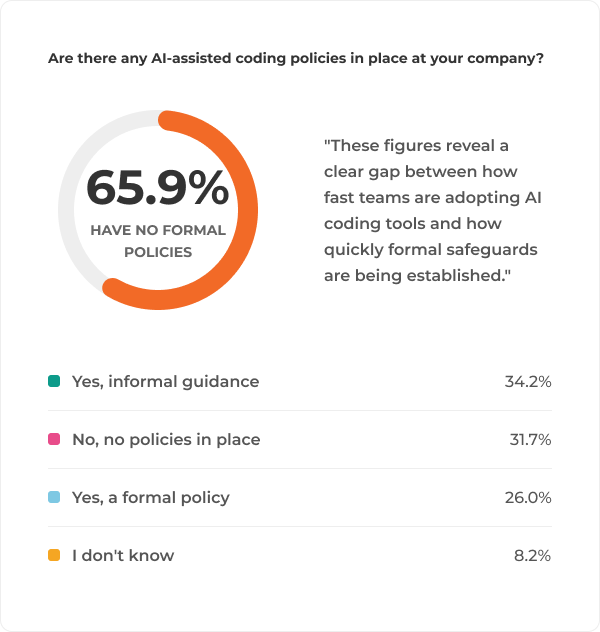
These figures reveal a clear gap between how fast teams are adopting AI coding tools and how quickly formal safeguards are being established.
As AI becomes further embedded in the development lifecycle, defining clear boundaries and governance structures will need to become a far higher priority for leadership teams.
Conclusion
The findings show that AI coding tools are delivering clear productivity gains, but workplace policies and safeguards are struggling to keep pace. Limited formal code reviews, widespread self-testing and growing security concerns suggest that businesses are trying to balance the benefits of vibe coding against its risks.
Closing the gap between confidence in AI-generated code and the processes used to review it will be essential if organisations want to keep their code secure, reliable and scalable.
Do you regularly use AI coding tools in your role? How would you rate the quality of the code they produce? And has your organisation introduced clear policies, or are you working with informal guidelines? Let us know in the comments.
Methodology
20i surveyed 600 non-developers based in the US to understand how vibe coding is being used in the workplace.
Data correct as of August 2026.