


Katie Keith is co-founder and CEO of Barn2, a software company best known for its WordPress plugins and increasingly for its work across Shopify and cloud based products.
Katie is also a prominent voice in the WordPress ecosystem, speaking regularly about the realities of building and growing a product business in the space.
Having grown Barn2 from a WordPress agency into an international software business with a fully remote team, she has first hand experience of product strategy, remote leadership, content led growth and the changing economics of WordPress.
In this insightful interview, Katie discusses…
- Why Barn2 moved away from client work
- How she manages a distributed team
- What AI and changing search behaviour mean for WordPress businesses
- Why Barn2 is expanding beyond WordPress
- The lessons she has learnt from running and growing the company
- … and much more!
Barn2 started as a WordPress agency before you pivoted to selling plugins. What was the tipping point that made you decide agency work wasn’t the right long-term model?
Running a WordPress agency gave me a much better work-life balance than having a traditional job for a company, but it still didn’t give me the flexibility that I ideally wanted.
My husband and business partner Andy and I had been talking for years about how we wanted to sell WordPress products, but we simply hadn’t got around to building anything.
The client work was just too distracting, because the clients always needed to come first before our own internal projects. I can’t remember what the tipping point was (maybe the psychology of New Year!), but in January 2016, Andy decided to take a step away from the client work and work full time building WordPress plugins.
We were in the fortunate position that we could do this, because I could project manage all the clients and we had a team of freelance developers to do the more technical work.
Allocating proper resources to the plugins was exactly what we needed, and it allowed us to launch our first one in March, which started getting sales very quickly.
You’ve built Barn2 with a fully remote team. What’s made that model work for you, and where has it created challenges as the company has grown?
One of the reasons we pivoted to selling plugins was that we didn’t want to grow a traditional agency with an office and everybody working together under one roof.
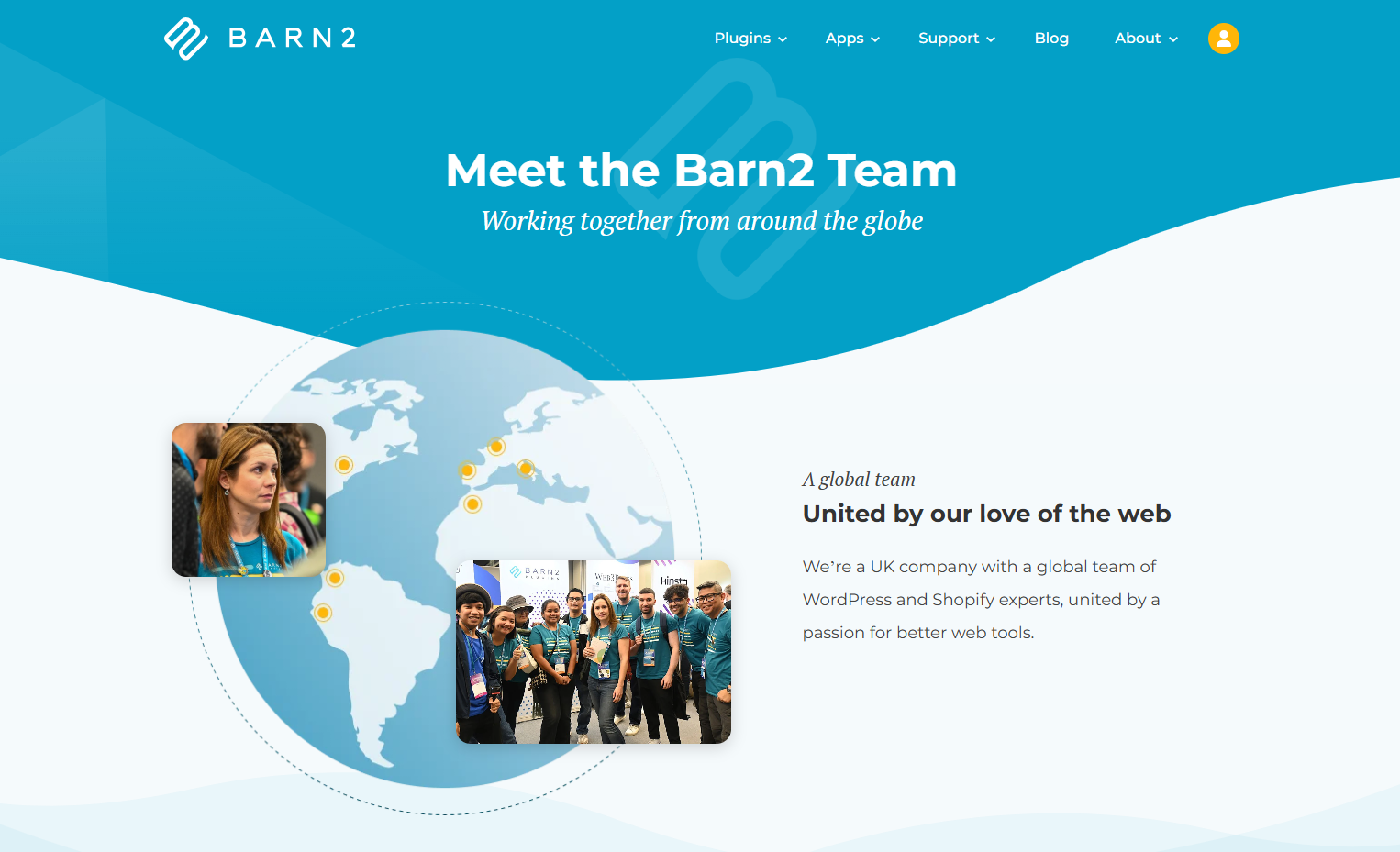
We switched to plugins thinking that it would allow us to remain smaller and do everything ourselves.
That did work for a few years, but as our sales grew it was no longer realistic for us to do all the support and development ourselves.
However, by then the world of work had changed and remote work was now the norm in the WordPress space.
We were able to grow a team without any of the lifestyle limitations that we had been worried about when we had the agency.
For me, lifestyle comes first, and a remote team means that you can build a larger business without feeling guilty whenever you’re away from your desk. I work hard, but that may not always be traditional hours.
Some days I might work evenings and weekends, other days I take time off and go out with my friends or family. Because we’re a remote team, that doesn’t set a bad example for them.
I’m not a city person. When we started selling plugins, we lived in southwest England, which isn’t an area where you would typically find the best tech talent. I now live on the island of Mallorca, which is even worse.
However, having a remote team means that my location is irrelevant to my ability to hire. Instead, I can hire the right person for the job wherever they are in the world. It also means that we can provide support across multiple time zones, which is better for our customers.
Some people think that remote teams can’t be as close or as well bonded as physical teams. That’s probably true to some extent, but I don’t think it’s a serious problem.
We meet up at WordPress events and are in constant communication electronically, for example in ClickUp chat. We also have a monthly social call where we play a game together online.
A lot of people who work in WordPress are introverts who prefer to work alone, so working remotely is a good fit for them. They’re part of a team, but they also keep their independence.
Of course, being a distributed team has brought challenges as the company has grown.
- The biggest one is that some people are more suited to working remotely than others.
- They need to be excellent communicators, and as the manager, I need to be able to see that they are working hard and making progress, given that I can’t tell when they’re physically at their desks.
- They also need to be self-organized and able to manage their own workload, because it’s not realistic for me to micromanage people on the other side of the world (and I wouldn’t want to anyway!).
However, once you get the right people, it’s an excellent way of working.
You’ve spoken about tracking how you spend your working time. What did the data reveal that surprised you, and has it changed how you operate as a CEO?
Just under a year ago, I did an audit of what I spent my time on as CEO.
The things that surprised me were how much time I spent on tasks I don’t personally enjoy, and how many low-level tasks I still do which should be done by someone more junior.
At that point I had a team of about 18 people and yet I still wasn’t good enough at delegating!
I made several major changes as a result of the audit. This included delegating some specific low-level tasks that I should not have been doing, and hiring a marketing coordinator to handle a lot of the marketing tasks that I’d been doing on my own.
Another thing that surprised me was that some of the most enjoyable parts of my role are podcasts, going to events, and building my own “personal brand”.
I had always had mixed feelings about these types of work, because while they raise the profile of the business and probably increase the value of the company, they don’t tend to generate sales or have direct, measurable business benefits.
➡️ Recognizing that these tasks helped me to enjoy my role allowed me to accept their value more readily. Sometimes it doesn’t matter if you can measure the results, and it’s important for CEOs to enjoy their work and avoid burnout.
There’s a lot of noise about how AI and vibe coding are going to eat into WordPress’s market share. Where do you stand on this?
I think AI will have some impact on WordPress’s market share. WordPress has always provided an easy way for people to create their own sites, and now they can equally do this with AI.
A lot of people try to deny this by pointing out that it’s hard to maintain those sites once AI has built them. I think that argument is irrelevant, because the AI can easily make changes, so the website owner never has to learn how to update their site.
However, despite this, I think that only a small proportion of people will actually want to build their own website with AI.
The less technical side of the market will be more likely to use the new generation of website builders that use AI to create websites more quickly on existing platforms like WordPress.
This brings a range of benefits, such as the security and plugin infrastructure that you get with WordPress. For example, I recently vibe coded a website as a side project and decided to ask the AI to use WordPress so that I could install plugins for features such as contact forms, instead of reinventing the wheel.
Overall, I felt that the website would be more stable and secure if it was built on WordPress. This becomes even more important for business-critical websites, or sites with complex functionality such as ecommerce.
Vibe coding is also a threat to individual WordPress products such as plugins. I don’t think it’s responsible for people to vibe code a business-critical plugin which forms a central part of their website.
However, there’s nothing to stop people from using AI to build minor features. As a result, small utility plugins are under the biggest threat. Unfortunately, we have several of these at Barn2!
As search traffic becomes less predictable and more product research happens through AI tools, how are you changing Barn2’s approach to content marketing and customer acquisition?
The move from organic search to AI search has been disastrous for Barn2. Our new sales have been declining steadily for two years, and I believe this is the reason.
We always ranked very highly in Google organic, and while AI regularly recommends our plugins, this generates far fewer sales than when people used to find us directly in Google.
I think this is because AI recommends us alongside other solutions, and the experience of reading about a product in AI is very different from visiting that product’s website immediately.
When people arrive straight on our site from Google, they are likely to make a purchase after seeing our professionalism, trust factors, calls to action, newsletter signups and all the other things that don’t appear in AI recommendations.
We need to change our approach to marketing and customer acquisition as a result. Content is still important, and we need to focus on ensuring that AIs are consistently recommending our plugins, as well as continuing with traditional SEO methods. Fortunately, there’s a lot of overlap between the two and they’re not mutually exclusive.
However, this alone will not recover our lost sales. We need to get much better at other types of marketing, such as cross promotion with other companies, partnership opportunities, and building products that sell through other channels.
You’ve transitioned to also developing Shopify apps and cloud-based products. Do you see Barn2 increasingly becoming platform agnostic? If so, does that added development complexity present new challenges for you?
Our expansion into Shopify apps and cloud-based products is a direct response to the drop in sales of our WordPress plugins.
While we have used techniques such as Google organic and YouTube to promote our Shopify apps, the vast majority of installs come from the official app store.
This helps to protect Shopify apps from the threats facing industries that rely more on organic SEO.
When we started building Shopify apps, I thought that we’d need to hire developers with a completely new skill set. I then discovered that you can use any technology to build a Shopify app, so my existing developers were able to pivot and have enjoyed the experience.
More recently, we released a cloud version of our Document Library Pro plugin: documentlibrary.pro. While this is a SaaS that allows you to add a searchable document library to any type of website, it’s actually powered by WordPress under the covers. This means that it fits with our existing skill set while appealing to a much wider audience.
What have you learned about international growth, particularly when customers in different markets have different expectations?
In many ways, international growth for a software company is remarkably easy.
You don’t have to worry about the challenges facing traditional physical products, such as overseas shipping. Your software business is international from day one.
We have had to do quite a bit of work to make sure everything works internationally.
You need to handle sales tax based on each country’s legislation. This puts some people off, but there are plenty of services that can handle it for you. We even launched a plugin to do it for sites that sell using Easy Digital Downloads.
You also need to make sure your software is easily translatable and ideally contains built-in translations. Don’t forget details such as supporting special characters and right-to-left languages.
The Barn2 website is only available in English, yet we still get sales every day from customers all over the world.
What advice would you give to someone who wants to start public speaking, based on your own experiences?
If you’re not confident with public speaking, then I advise starting small and building your way up. I did my first talk jointly with someone else, which removed some of the pressure.
Beforehand, I filmed myself doing part of the talk and posted it on X for feedback. This went well, and people were very helpful while being kind at the same time.
I also watched lots of YouTube videos about public speaking. These seem to focus a lot on mannerisms, and I spent some time trying to learn the right mannerisms. When I eventually filmed myself and did some real talks, I discovered that I do those same mannerisms automatically without thinking about it!
As a result, I believe you can overthink this, and it’s more important to be yourself.
My first solo talk was a ten-minute lightning talk. Again, this felt much less intimidating than doing a full-length talk immediately.
It was only after all that that I did my first full-length talk alone. This was at a relatively small event, which again removed the pressure.
My other piece of advice for someone who wants to start public speaking is about how to convince the event organizers that they want you as a speaker.
As a woman in tech who owns a reasonably well established company, this has always been quite easy for me. I recognize that it might be harder for other people.
My advice is to analyze the topics and titles of talks at previous editions of the event, and craft an idea which is a perfect fit for their audience. Write a killer outline which directly explains why it’s the perfect talk for the event. If you don’t have videos of previous talks you’ve done, then try to provide something equivalent, such as a YouTube video or livestream of you presenting.
What’s one goal you have for Barn2 that you’re really excited about achieving?
I’m really excited to see our new products grow and how successful they will be. We’ve been exclusively selling WordPress plugins for ten years now, so expanding beyond WordPress feels like the natural next step of the journey. I can’t wait to see how it goes.