


Your client’s new website just went live 🥳
It’s been weeks of planning, design revisions, late-night content tweaks and now the launch email has landed. Traffic’s building, orders are starting to come in, and everything’s on track.
Then the site slows down. Pages take seconds to load. Checkout stalls. Panic sets in 😱
You check your monitoring tools. The server load is stable. No downtime, no spike in errors. Yet performance is tanking.
This is a scenario every reseller dreads.
To the client, it looks like a hosting failure. To you, it’s a mystery, until you realise the problem isn’t the server. It’s the limits imposed by the hosting platform itself.
The Limitations Of Single Server Shared Hosting
On most shared hosting setups, including those built on cPanel with CloudLinux, every website runs inside a container with fixed CPU and memory allowances. These are known as LVE (Lightweight Virtual Environment) limits.

Once those thresholds are reached (even temporarily) the site stalls. It doesn’t matter if there’s capacity available elsewhere on the server.
The container has no headroom, and your client’s site hits the ceiling.
The frustrating part? Clients don’t see the container. They see you. You’re the one who recommended the hosting, and now their site is unresponsive during a key moment.
This is the silent cost of conventional hosting limits and it’s why understanding (and avoiding) LVE restrictions is more important than it might seem at first glance.
What Are LVE Limits and Why Do Hosts Use Them?
LVE is a resource management system built into CloudLinux, which underpins most traditional shared hosting platforms.
At first glance, it sounds like a good idea: every user gets a defined slice of CPU, memory and other server resources. That way, one customer can’t hog everything and affect the others.
But in practice, it’s a blunt instrument.
When a site hits its assigned resource limits (e.g. during a traffic spike or a poorly optimised plugin) it doesn’t just slow down. It can stop responding entirely.
What’s more, those limits don’t adapt. Even if there’s plenty of capacity elsewhere on the server, the site inside the container remains throttled.
You’re left with underused infrastructure and a site that’s underperforming.
Hosts use LVE because it’s easy to manage. It allows them to cram more sites onto a single server without the risk of one causing trouble for the rest. But this model assumes every site will stay in its box and punishes them when they don’t.
For resellers, that’s a problem!
Your clients don’t care about container limits. They expect their site to work, especially when they need it most.
LVE might protect the host’s infrastructure, but it doesn’t protect your client’s experience.
➡️ Read more about LVE Limits.
Why LVE Limits Hurt More Than They Help
On paper, LVE limits sound like a safety net. In reality, they often work against the very sites they’re meant to support.
They don’t just prevent bad actors from abusing resources, they restrict legitimate growth.
Say your client runs a campaign that performs better than expected. Traffic doubles, maybe triples. It should be a success story.
Instead, their site hits its CPU or memory limit, and performance nosedives. Checkout hangs, forms fail to submit, and pages stall.

Your client’s visibility peaks at the same moment their user experience collapses.
It’s a lose-lose.
Worse still, diagnosing LVE-related slowdowns is rarely straightforward. From your dashboard, the server looks healthy.
Support might not see a fault. And your client doesn’t understand why performance is tanking if they’re nowhere near their plan’s stated “limits”.
You end up explaining abstract thresholds and background processes when what your client really wants is a fast, stable website.
In short, LVE limits shift the risk of performance issues away from the host and onto you. That risk grows with every successful client site you host.
How 20i’s Platform Does Things Differently
Unlike traditional shared hosting environments, 20i doesn’t rely on LVE containers to manage resources.
Instead, our entire platform is built on a true autoscaling architecture that allocates resources dynamically across a pool of servers.
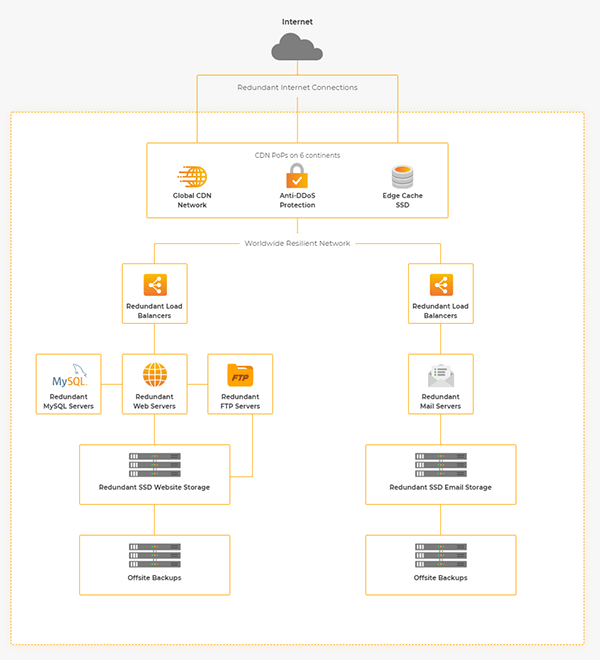
There are no fixed caps on CPU or memory for individual websites. If one of your client’s sites experiences a sudden surge in traffic, our platform scales to meet demand in real time, without throttling, without downtime and without penalising success.
Because we don’t use single-server setups, your sites aren’t competing with dozens of others inside a fixed container.
They draw from a much larger pool of capacity, which means even unexpected traffic spikes won’t break performance. You’re not at the mercy of arbitrary resource limits. You’re backed by a platform designed to absorb growth, not restrict it.
This is an advantage you can pass directly to your clients. When they need more performance, they get it. No delays. No compromises and no hidden constraints holding them back.
What This Means in Practice (For You and Your Clients)
Hosting without LVE limits changes the experience of managing websites for both you and your clients.
When you’re running a design agency, freelancing for multiple businesses or managing hundreds of sites as a white-label host, performance issues are more than an inconvenience.
Every support ticket about a “slow site” or a failed campaign launch is time you didn’t plan to spend and confidence you now have to rebuild.
Without LVE limits, you’re free to focus on delivery, not damage control. Whether your client runs an ecommerce store with flash sales, a viral blog post or a growing membership platform, you don’t need to second-guess if their traffic will cause problems.
From your client’s perspective, their site just works. It loads fast, even when visitor numbers spike. They don’t see CPU thresholds or memory caps, they see results. And when performance is seamless, trust grows. So does retention.
For you, that means fewer reactive issues and more room to upsell, grow your portfolio or expand your services.
Selling the Invisible: How to Talk About LVE-Free Hosting
Most clients don’t care how hosting works. They care that it works.
That it’s fast, secure and doesn’t fall over when things get busy. So when you’re explaining the value of 20i’s no-LVE, autoscaling platform, avoid the technical jargon and focus on what it enables; resilience, speed, trust and growth.
Frame the benefit around outcomes
Don’t lead with “no LVE limits”. Lead with:
- “Your site stays fast, even when traffic spikes.”
- “You won’t hit an artificial cap that slows your site down.”
- “Your campaigns, launches or flash sales won’t backfire because of your hosting.”
The technical details are supporting material and not the headline.
Use analogies clients understand
Analogies make technical differences more tangible:
- Traffic lanes: “Most hosting plans put your site in a slow lane. If too many cars join, you stop moving. With our hosting, more lanes open up automatically, so you never slow down.”
- Electric grid: “Traditional hosting gives you a fixed power supply. If you need more, the lights flicker. We give you an unlimited feed that scales with your demand.”
- Room size: “Imagine your site in a tiny room with a low ceiling. When it gets busy, it can’t breathe. Our platform removes the ceiling; more room, more air, better performance.”
Use scenarios that resonate
Help clients see where it applies to them:
- “You launch a Facebook ad campaign and suddenly get a flood of people on your site. Our platform scales automatically, so the site stays responsive and checkout stays quick.”
- “One of your blog posts goes viral. You don’t need to ‘upgrade’ or panic – it just works.”
- “A plugin update temporarily increases resource usage. Instead of crashing, your site gets the room it needs.”
Highlight your support benefits
For resellers, the lack of LVE limits is as much about your experience as your customers’.
- You get fewer support calls and complaints about speed.
- You don’t have to firefight every time a site gets busy.
- You spend less time explaining why a fast server isn’t helping, because the platform handles it.
Clients might not understand LVE. But they do understand:
- Losing orders during a busy sale
- A slow checkout killing conversion
- The importance of their site being reliable
Keep the conversation anchored on those priorities, and you’ll connect the dots between the platform’s flexibility and their business success.
Clients May Not Get It, Until It Saves Them
You can explain autoscaling. You can describe LVE limits. You can illustrate the difference in speed and stability. But for many clients, the penny only drops when things go wrong elsewhere.
It’s when a site hosted with a competitor buckles under a modest traffic spike. When another provider blames “resource limits” and suggests an upgrade. When they see that your hosting simply copes with no fuss, no throttling, no sudden charges.
That’s when it clicks.
For clients, LVE limits are invisible until they become a visible problem. For resellers, that’s your opportunity to stand out. You’re not just selling hosting. You’re providing assurance that their site will keep up when it matters most.
And in a space where trust is hard-won and easily lost, that level of performance becomes part of your value proposition. It’s what helps you retain clients, justify your pricing and scale without sacrificing reliability.
When a client sees their busiest day go smoothly, when their promotion works exactly as planned, and their site stays fast from first click to checkout, that’s when they understand what your hosting really offers.