


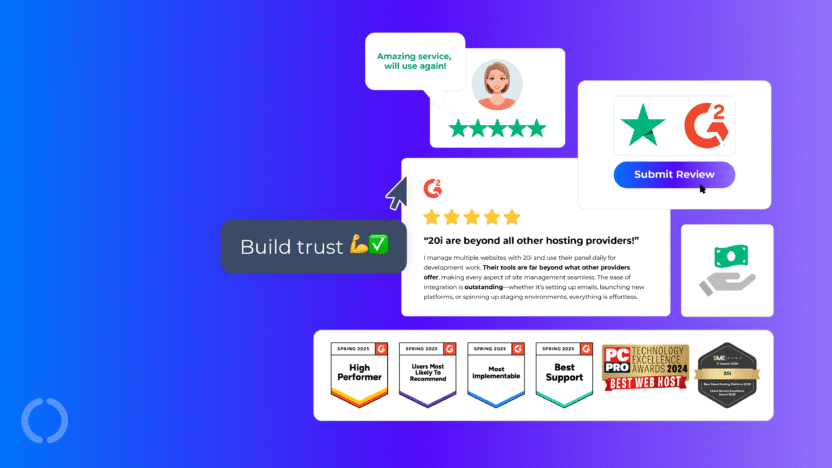
Using social proof on your website helps build trust, reduce hesitation and shows prospective customers that real people have had great results with your service.
But how do you actually get authentic and compelling testimonials?
I’ll share easy tips and best practices for gathering social proof and testimonials from your customers.
Before we get started, here are some of the ways we’ve used trustmarks throughout our website to build trust with prospective customers:
Be proactive
Testimonials are rarely given without being asked for, so you need to be proactive. Don’t just expect that customers will take the time to leave feedback, even if they’ve had a fantastic experience.
Build feedback reviews into your regular processes so that every satisfied customer has a clear and convenient opportunity to share their experience.
Review requests should be the last part of your customer journey, allowing you to turn satisfied customers into advocates who help build up trust and credibility for you and your brand.
Qualitative feedback Vs quantitative feedback
Both qualitative and quantitative feedback are crucial, but they serve different purposes. To get the best results, collect both.
Qualitative feedback
This is the more descriptive feedback you can turn into testimonials, case studies, and use for marketing copy. Here’s how to get it:
Email outreach – Target customers who have previously expressed enthusiasm for your product or service in previous support interactions. Invite them to “share their story.” This is also a good opportunity for them to market their product or service.
1:1 interview – Reach out to top customers or those with compelling success stories. Ask for a brief call or written Q&A. Ask open-ended questions about their challenges, goals and results using your product or service.
Surveys – Ask customers to complete a few quick questions that will shine a positive light on your business.
Quantitative feedback
Quantitative feedback is more structured and measurable and can be gathered in higher volumes, it helps you spot patterns and track satisfaction levels. Here’s how to get it:
NPS surveys – Ask simple questions post-purchase or post-service like, “How likely are you to recommend us on a scale of 0–10?” You will get easy and measurable results.
Customer satisfaction survey – After a support interaction, whether on the phone or chat, ask “How satisfied were you with the support you received today? Satisfied, somewhat satisfied, or not satisfied.”
Ratings on review sites – Add links to your review sites like Trustpilot or G2 at the end of support interactions.
Star ratings – Add a visual 1–5-star rating after support interactions or in post-purchase follow-up emails.
Reduce thinking time
It’s important to remove as much friction as possible from the process of gaining feedback.
Simply asking, “Can you write a testimonial?” puts pressure on the person to come up with the right words, and think back to specific positive experiences, often leading to vague feedback or no response at all.
Instead, guide them. Try providing a short list of questions to get them started. For example:
- What made you want to do business with us?
- Have you had any good experiences with a member of our support team? If so, can you give an example?
- Would you recommend us to others? If so, why?
These prompts give your customers a clear structure to follow, which makes the task easier and helps them focus on what really matters to potential customers.
The easier you make it, the more likely you are to get testimonials that are thoughtful, authentic and exactly what you want your customers to share.
Don’t just tell them where to leave feedback, show them
If you want more reviews on Trust Pilot for example, don’t just say, “Please leave us a review on Trustpilot.” Make it as easy as possible by sending a direct link straight to the exact page where they can leave their review.
The less friction involved, the higher your response rate will be. Customers are far more likely to follow through when they don’t have to search for your profile or figure out the steps themselves.
The less friction to get there, the more likely they are to leave review.
Ask at the right time
Timing is crucial when requesting reviews. The best moment to ask is when your client is feeling most positive about your services, like just after a difficult query has been resolved or soon after a project has been finalised. Or for a physical product, a few days after the customer has received the item, so they’ve had time to use and test it.
That’s when their enthusiasm is highest, and they’ll be more eager to share specific, compelling details about their experience with you.
If you wait too long, that excitement can fade.
Build testimonial requests into your project handoff or post-launch process. A simple follow-up email can dramatically increase both the quantity and quality of the feedback you receive.
The goal is to get genuine, timely reactions that highlight the real value your business delivers to resonate with future customers.
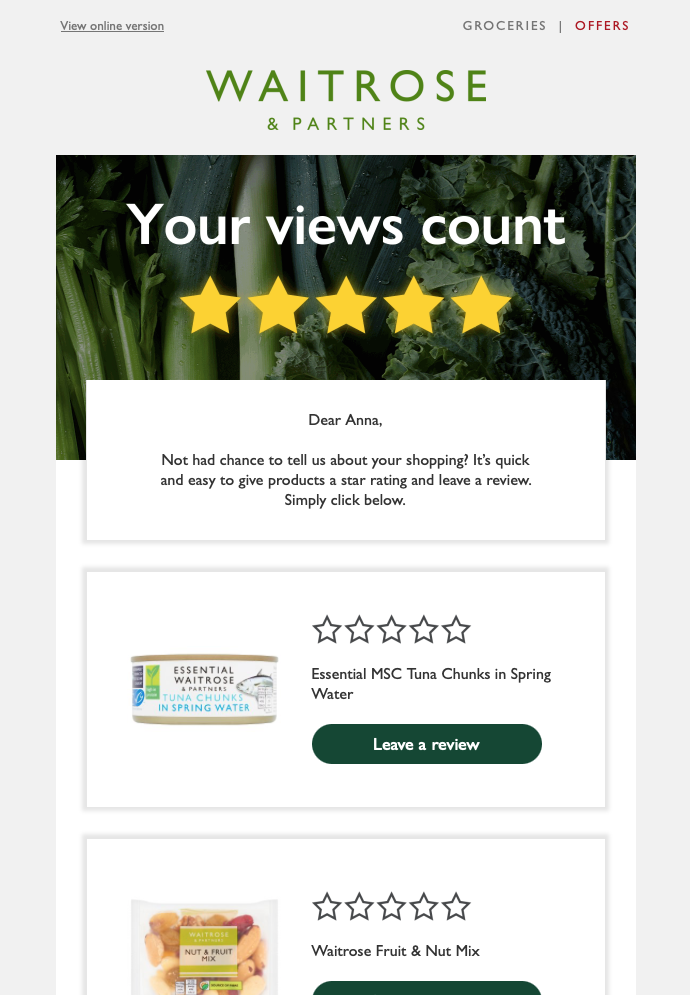
The example above shows a follow-up email from Waitrose sent after a recent in-store purchase. Within 24 hours, they reached out inviting me to review specific products.
Waitrose makes the process clear and straightforward by including copy explaining it will be ‘quick and easy’, and including direct links to the review page, hence removing any frictional barriers.
This approach is effective because it’s timely; I’ve now had long enough to try or use certain products, highly targeted and designed for ease.
Offer incentives
If you find yourself struggling to gain feedback, you can consider encouraging customers to share feedback by offering incentives.
Small rewards can show appreciation to your customers without compromising on authenticity. For example, common incentives are:
- A discount on their next service or purchase
- A voucher, or money off, a particular product or service
- An entry into a prize draw
- A free add-on or upgrade
These kinds of incentives add genuine value for your customer while encouraging them to take the time to write a quality testimonial.
Incentives help both sides: you get meaningful social proof, and your clients feel appreciated and supported for helping your business grow.
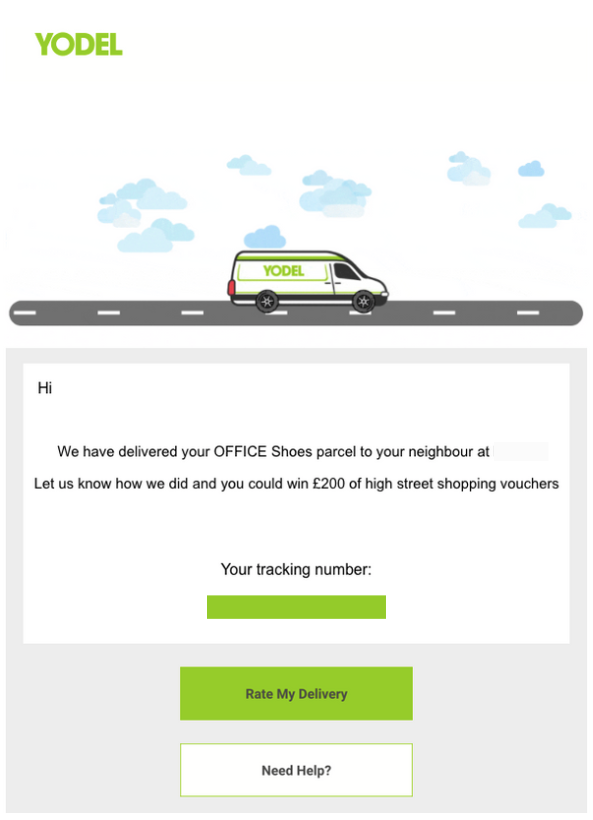
The example above shows another follow-up email I received a few days after a parcel was delivered by YODEL. In this email, they offer an attractive incentive, the chance to win £200 in shopping vouchers simply for rating their delivery service.
This approach is smart for both me, the customer, and for them. For me it’s a clear win, the chance to win a reward of high value for just a minute of my time. For YODEL, it’s an effective strategy to generate a high volume of reviews by motivating more customers to share their feedback.
Keep it consistent
Make collecting testimonials an ongoing part of your business process, not just something you do when you remember.
It’s important to keep your testimonials current, as outdated ones from years ago can be off-putting to potential customers.
Set up a system or process:
- Add testimonial requests to project wrap-ups (like follow-up emails)
- Automate review requests after purchases or support tickets
Consistency helps you build a steady stream of social proof, so you’re never short of an up-to-date quote or customer story.
To conclude
Gathering effective social proof doesn’t have to be complicated, it just takes a little planning and the right approach.
Ensure you make it easy for customers to share their experiences and keep these four key principles in mind:
✅ Be proactive
✅ Make it easy
✅ Ask at the right moment
✅ Offer incentives
Soon, you’ll build a collection of authentic, persuasive testimonials that truly showcase the value of your business.
Upgrade your hosting 📈 Unleash your websites 🚀
Build, deploy & manage all your sites/apps at scale. Use our high-spec cloud servers to ensure blazing-fast load times, every time. Get market-leading speed, security & customer support.
- WordPress, WooCommerce, Laravel optimisations & more
- One click migration from any host, any time
- Free Email, DNS, CDN, SSL, SSH, Backups, Security & Git integration all baked-in
- Global reach with 60+ global data centres
- Award-winning support from real people
Find out why over 1 million agencies, online stores, developers, multi-site hosting and high traffic sites use our Managed Cloud Servers to ensure peak performance, every time.