



As shoppers spend billions of dollars in the lead up to Thanksgiving, Black Friday, and Christmas, more people are turning to online stores, with over $1 trillion spent in 2024.
With so many people browsing at once, retailers face growing pressure to keep their sites fast, to prevent customers getting frustrated and abandoning their carts.
Research shows that younger generations now have significantly shorter attention spans, averaging just eight seconds for Generation Z, so it’s no surprise that websites lose traffic when pages load slowly or become overloaded.
In 2024, 70% of all online shopping carts were abandoned, with 17% of those attributed to website crashes.
How we measured site speed
Using Google’s Core Web Vitals data – measuring page speed and accessibility – we analyzed 350 of the largest online retailers across various product categories in the U.S.
We then created a weighted index score for each sector (out of 700) based on these results, revealing which sectors are most at risk of losing revenue in the peak season on mobile and desktop.
Summary of the Core Web Vitals used to create the report:
- Core web vitals assessment: Overall Pass/Fail score based on LCP, INP and CLS.
- Largest Contentful Paint (LCP): How fast the main content loads.
- Interaction to Next Paint (INP): How quickly a page reacts to user interaction.
- Cumulative Layout Shift (CLS): How stable the layout is when loading.
- First Contentful Paint (FCP): How quickly the first visible content appears.
- Time to First Byte (TTFB): How long it takes the browser to receive the first byte of data.
- Accessibility Score: Overall usability rating for all users.
How well do US websites perform overall?
The report analyzed major US retail sectors including health and wellness, finance, fitness, pets, fashion, gaming, home, electronics, streaming, beauty, travel, and retail.
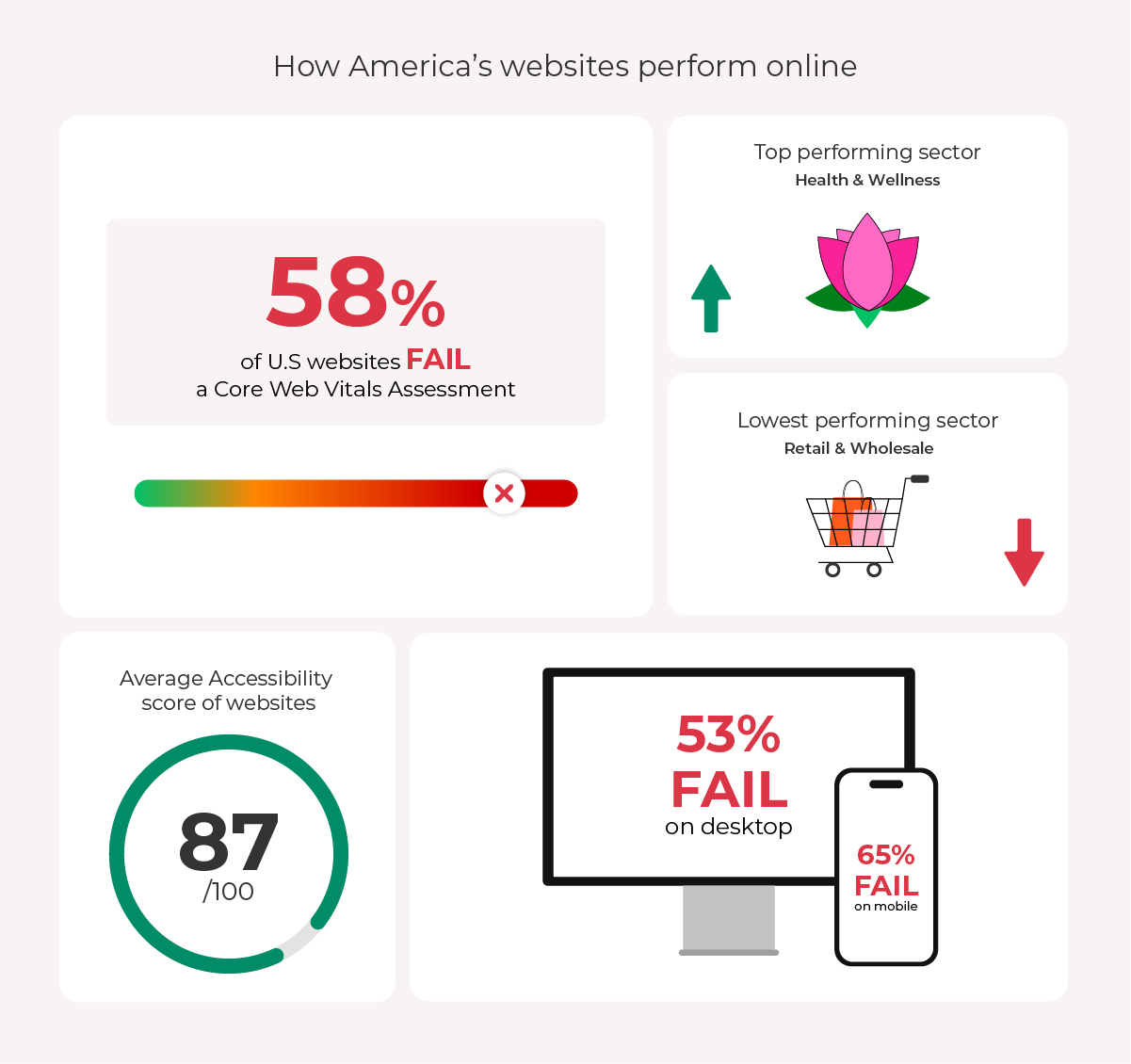
Across all sectors, 58.2% of US brands fail a core web vital assessment across mobile and desktop devices combined.
➡️ The health and wellness sector led performance with 55% passing, while retail and wholesale performed the poorest, with 76% failing.
Accessibility remains a key factor in overall user experience. The average accessibility score across all sectors was 87, with health and wellness websites scoring highest at 91 and retail and wholesale lowest at 70.
Top performing websites by sector
Health & Wellness Sector Wins Out
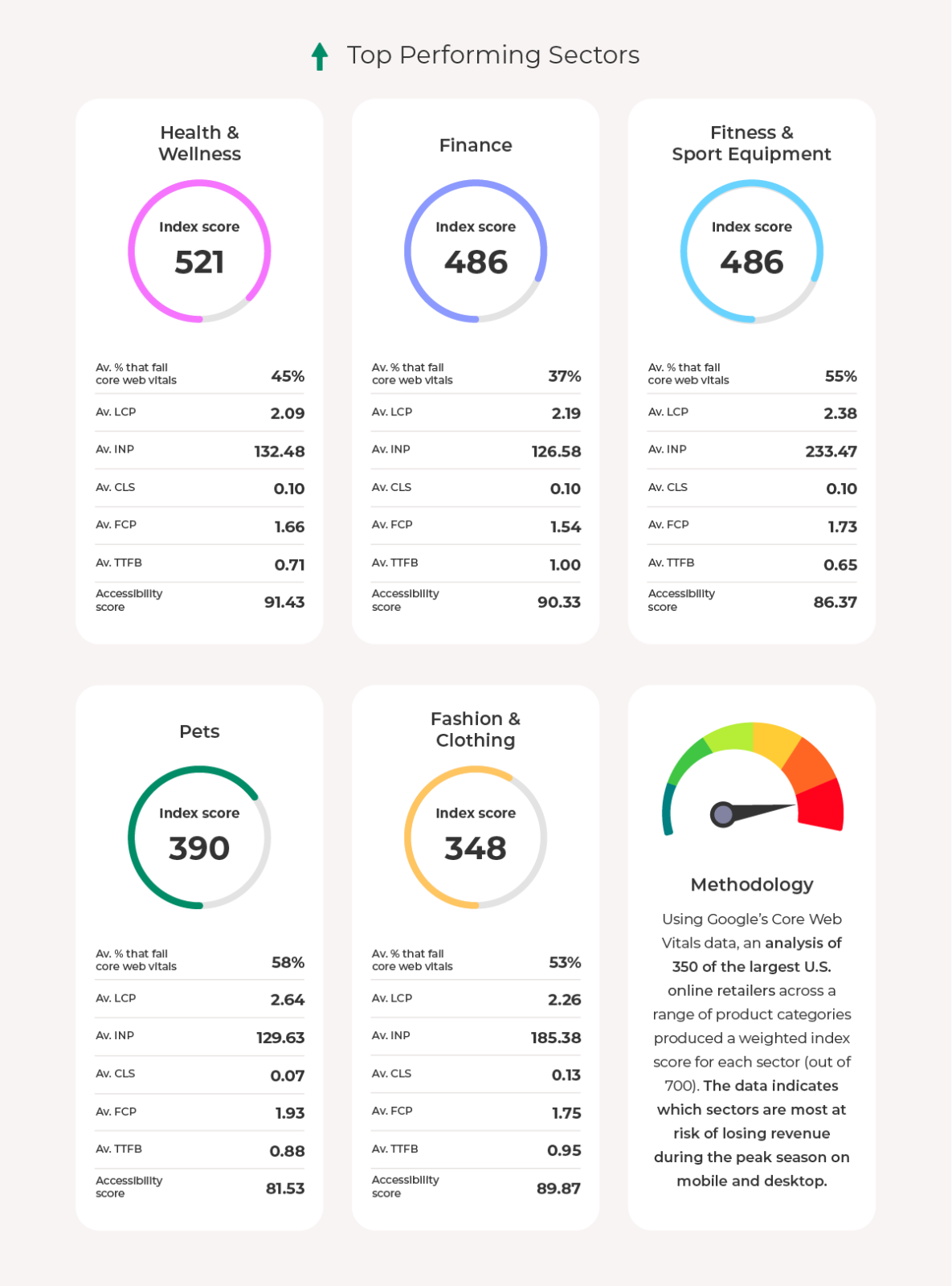
The health and wellness sector performed best overall across mobile and desktop, which is good news for shoppers looking to stock up on products or benefit from program deals during Black Friday promotions.
These websites had an average INP of 132ms, indicating excellent responsiveness, and an LCP of 2.09s, the best among all sectors, meaning content loads quickly and users can start engaging with offers without delay.
Financial Services
Ranking second is the financial services industry, with the highest core web vitals pass rate among all sectors analyzed, at 62.5%.
Covering rewards programs and alternative payment options – which see higher traffic before Black Friday and Christmas as shoppers seek flexible payment options – finance sites averaged an INP of 126ms, LCP of 2.19s, and accessibility score of 90, indicating fast, user-friendly pages and a smooth overall experience.
Fitness
Ranking third, the fitness sector sees heavy traffic around events like Black Friday as shoppers look for big-ticket equipment.
The sector’s average TTFB of 0.65s is acceptable, while an INP of 122ms and LCP of 2.38s show strong interactivity and speed, helping retailers manage high demand smoothly.
Pet Market
The lucrative pet market came in fourth, for those seeking food, toys and gifts for their beloved four-legged friends.
With the lowest CLS score at 0.07s and an accessibility score of 81.5, the sites are visually stable and easy to navigate.
However, moderate loading time from FCP and LCP scores of 1.93s and 2.64s may cause impatient users to leave.
Fashion & Clothing
Fashion and clothing ranked fifth, with strong INP (185ms) and LCP (2.26s) scores, and an accessibility score of nearly 90, indicating fast, responsive, and easy-to-navigate websites.
Ahead of the busy US holidays, maintaining, and even looking to improve, these performance levels is crucial to handle high traffic.
Worst performing websites by sector
Retail & Wholesale Sector Struggles With Page Speed
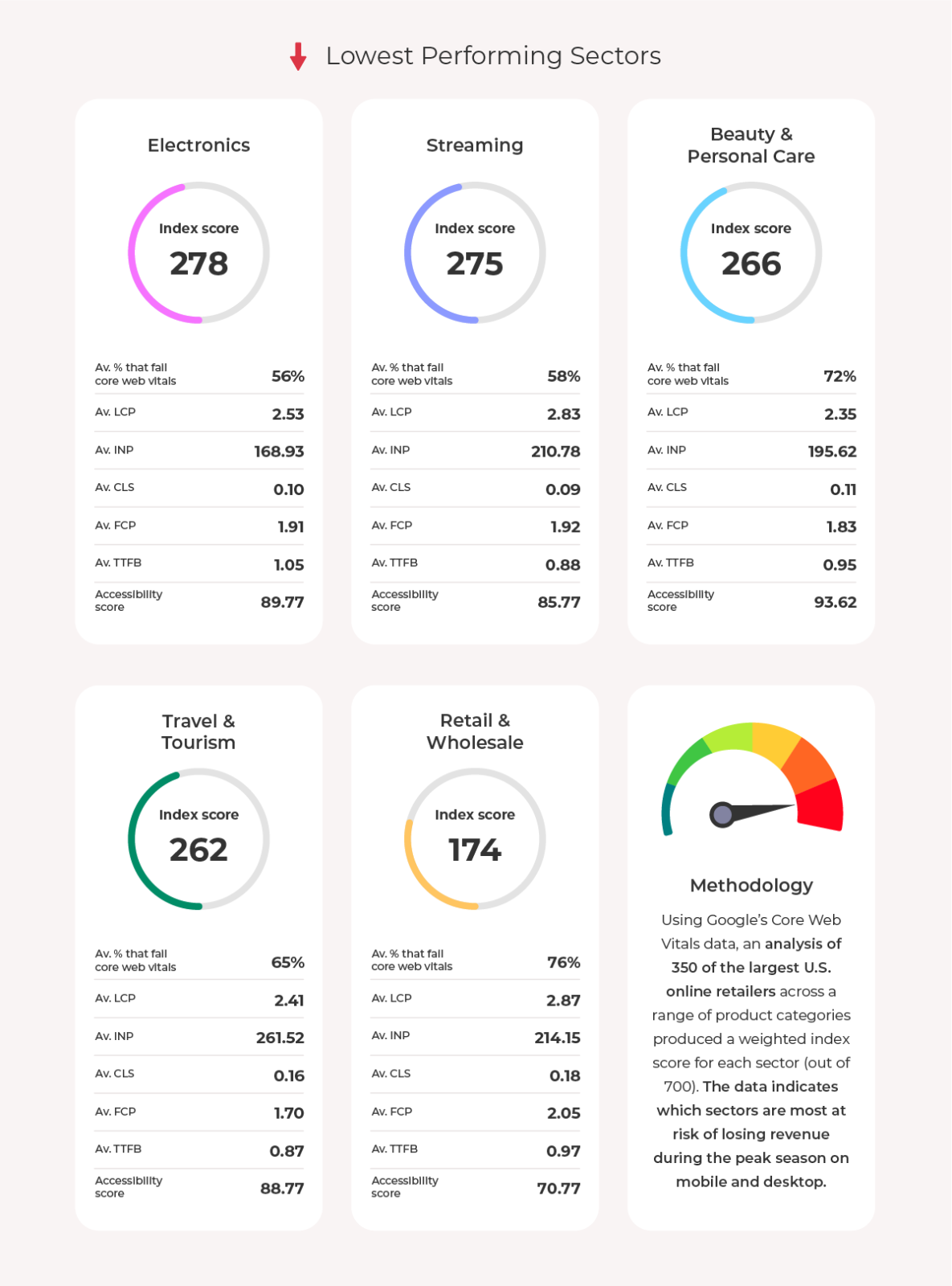
Ranking lowest overall, the retail & wholesale sector posted weak scores across six of seven site speed metrics. Sites had an INP of 214ms and an FCP of 2.05s at the time of analysis, showing moderate responsiveness but significant room to improve speed and user experience.
Travel & Tourism
The travel and tourism industry ranked second lowest with the highest INP of 261ms and CLS of 1.7s indicating lag and layout shifts, which could be seen as surprising for an industry that generates trillions of dollars annually in the US.
The websites did have a stronger accessibility score of 88, so after waiting time users are able to book their holidays more easily and with deals offered.
Beauty & Personal Care
The beauty and personal care sector is consistently one of the busiest sectors for spending around Black Friday and Christmas, yet 72% of sites fail a core web vitals assessment.
The analysis highlighted areas for improvement in content loading speed (LCP: 2.35s), layout stability (CLS: 0.11s), and server response time (TTFB: 0.95s). bThere’s easy navigation with an accessibility score of 93, but brands need faster performance to keep shoppers engaged.
Streaming
Streaming services also struggle with site speed, despite consistently experiencing and expecting high traffic.
While customers are prepared to pay for their streaming services, most providers still offer discounted rates around Black Friday, to remain competitive.
Platforms like Netflix, and HBO showed an INP of 210ms, indicating slight lag after user interactions, and an average FCP of 1.9s, reflecting a delay before content appears.
With 83% of Americans watching streaming platforms, especially with friends and family around the holidays, it’s clear that convenience is key and patience is limited when things take time to load.
Electronics
The electronics sector sees a traffic surge around Black Friday as shoppers wait for discounts on appliances, yet rounds off the worst five sectors for low web performance.
With an average FCP of 1.91s and LCP of 2.53s, pages show slight loading delays, though an accessibility score of 89 ensures smooth navigation for users who stay engaged.
Mobile vs Desktop
Looking at performance on mobile devices versus desktop devices is critical, as over half Americans who browse the internet do so via mobile (57%).
Yet, many brands still fall short.
➡️ On average, 65% of websites failed a core web vitals assessment on mobile devices, while 53% failed on desktop.
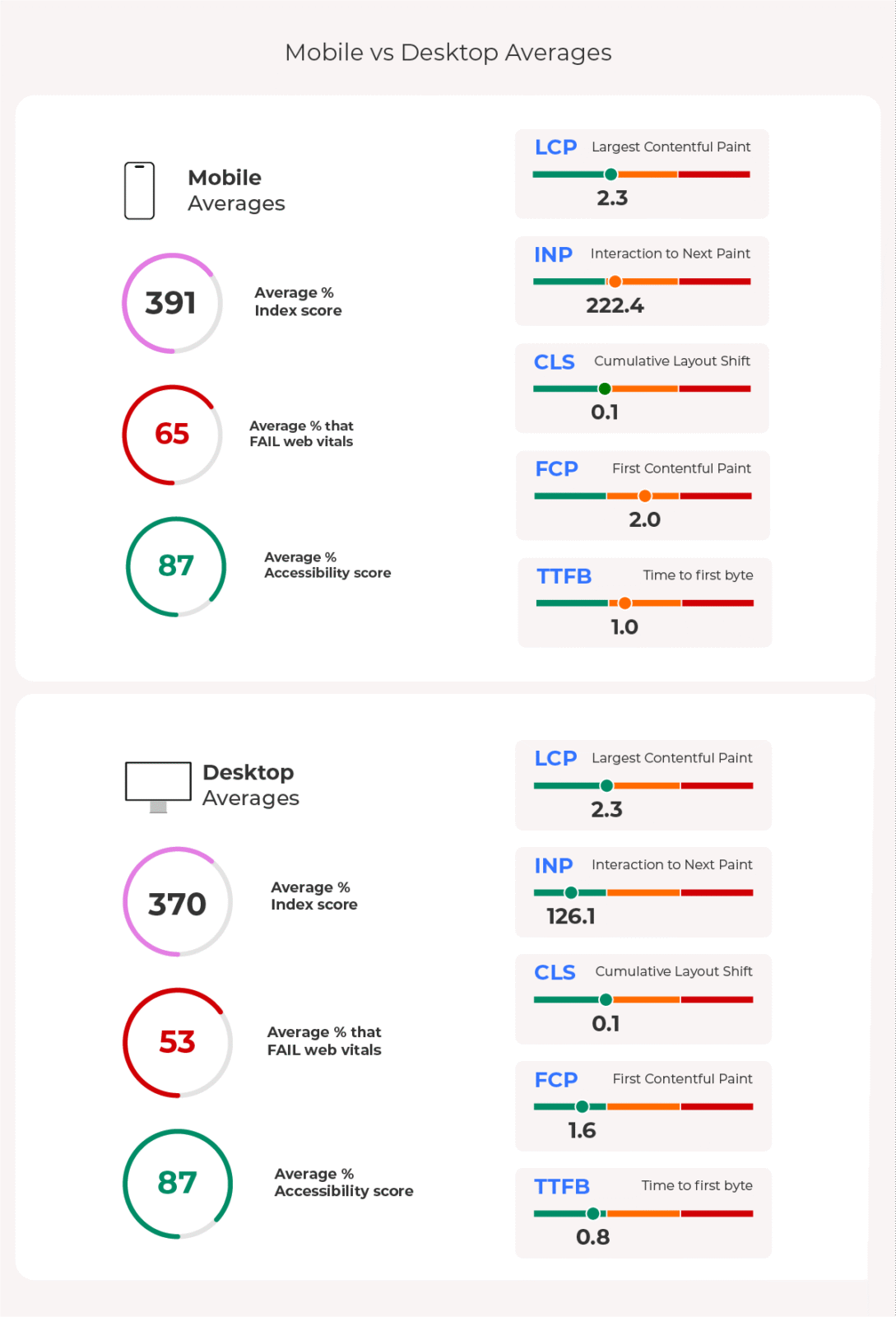
This suggests that many brands may struggle to provide a strong and smooth performance on smaller screens, which is essential around busy shopping times.
Average accessibility scores across both were nearly identical, at 86.9 on mobile devices, compared to 87.1 on desktop, showing a consistent level of accessibility regardless of the device being used.
While both these scores show that many sites are making efforts to be accessible, there is still room to improve speed and stability.
Promising results, but still room to improve
This report shows that many retailers still have room to improve their websites to ensure they run smoothly, efficiently, and provide a user-friendly experience.
With Black Friday in November, a time when shoppers rush to grab limited-time deals, retailers need to be prepared for heavy traffic and fast purchase decisions.
While unexpected issues can still occur, developers can implement proactive measures to minimise disruptions and enable quick recovery if problems arise.
What’s clear from the data is that performance gaps remain across several high-traffic sectors. Brands that act now to improve speed and stability will be best placed to capture demand and maximise sales during the holiday season.
There are plenty of tools that web builders can use to boost site speed and accessibility, and there’s still time for retailers to make improvements.
What can businesses do?
There are many things online businesses and web builders can do to prepare for high track volume ahead of Black Friday and Christmas.
Improving performance makes a big difference in both user experience and sales and ensures the website is ready to handle the surge in visitors.
Read our guides on how to speed up your website:
- First Input Delay (FID) – What It Is & How to Optimise It
- Interaction to Next Paint (INP) – What it is & how to optimise it
- How to optimise your WordPress database without any plug-ins
- What is pre-caching and what are the benefits?
- An introduction to WooCommerce database optimisation
- How To Optimise Your Website With Performance Testing
- What Is Redis Object Caching? (And How To Use It for Your WordPress Site)
- What is High-Frequency Hosting and who is it for?
Methodology
Our researchers used Google’s PageSpeed Insights tool to analyze Core Web Vitals data – measuring page speed and accessibility – for over 350 of the largest online retailers across various product categories in the U.S.
An average score for each metric was found by sector. A weighted index score for each data point was given by sector, then totalled (out of 700).
Sectors with the lowest overall index score were found most at risk of losing revenue in the peak season on mobile and desktop, and vice versa. Data correct as of October 2025.
Upgrade your hosting 📈 Unleash your websites 🚀
Build, deploy & manage all your sites/apps at scale. Use our high-spec cloud servers to ensure blazing-fast load times, every time. Get market-leading speed, security & customer support.
- WordPress, WooCommerce, Laravel optimisations & more
- One click migration from any host, any time
- Free Email, DNS, CDN, SSL, SSH, Backups, Security & Git integration all baked-in
- Global reach with 60+ global data centres
- Award-winning support from real people
Find out why over 1 million agencies, online stores, developers, multi-site hosting and high traffic sites use our Managed Cloud Servers to ensure peak performance, every time.